

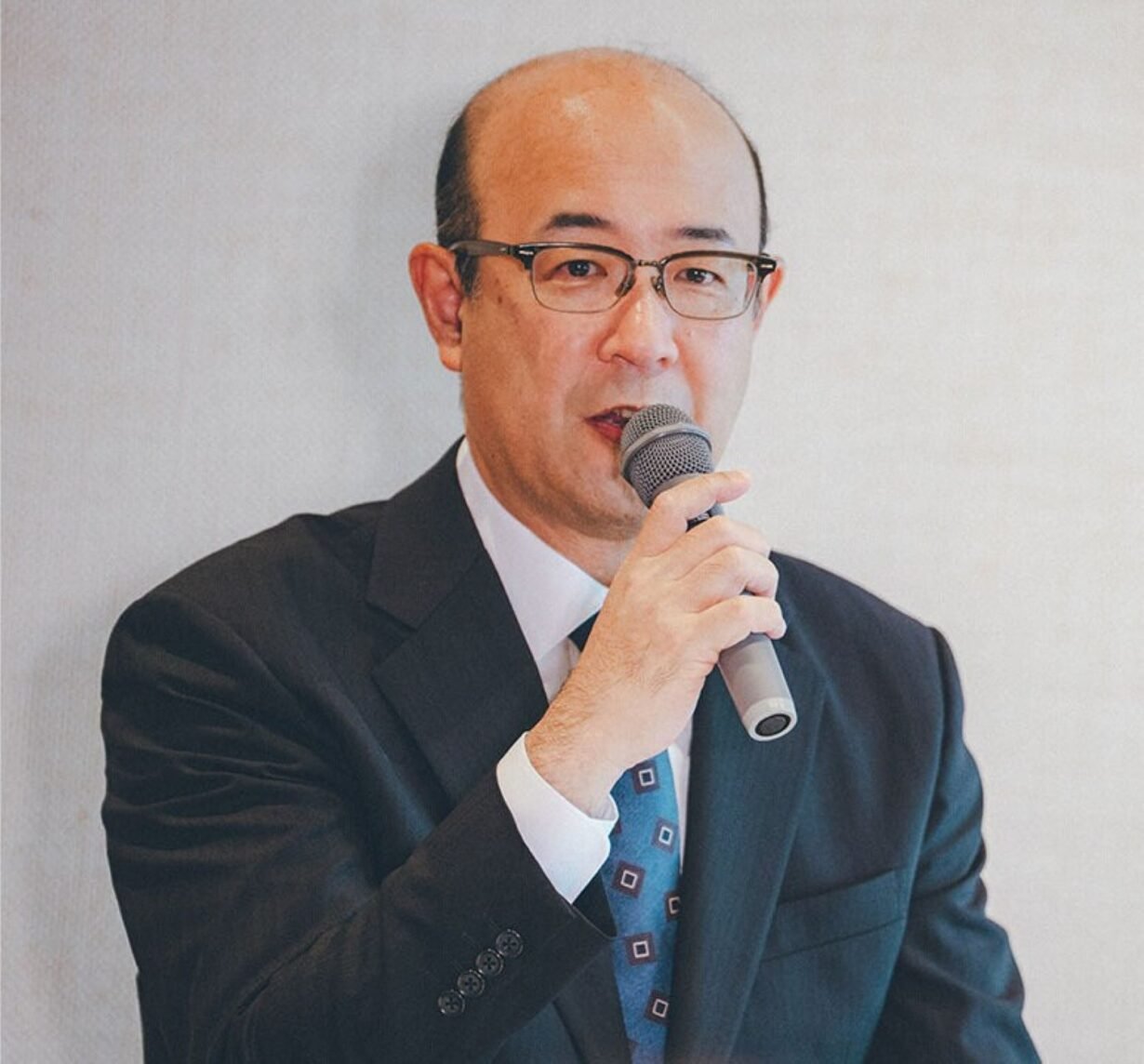
Toyota’s thirteenth president spent almost his entire career in finance, yet since taking office he has been visiting factories once or twice a week. There are still decisions that make him wonder what Akio Toyoda would do. He knows this reinforces the idea that he is too close to the man who chose him. It does not seem to worry him very much.
Kenta Kon was born and raised in Niigata and is now 58 years old. At school, he played bass in the music club. He joined Toyota in 1991 and for much of the following years remained fairly far from an assembly line: he built his career in accounting and finance.
In April 2020, he was appointed chief financial officer. He started with factories halted by the pandemic, dealerships closed and supply chains coming apart from one country to another. Then came component shortages and U.S. tariffs. For much of those years, it was his job to work out how the company could get through all of it without losing profitability.
He also spent time at Woven by Toyota, the software subsidiary that is developing, among other things, the group’s experimental city. His time there was brief, but he often mentions the experience. After so many years inside the same organization, for the first time he felt he could take a few steps back and look at it from the outside.
On April 1, 2026, he replaced Koji Sato as president and CEO. Sato moved to the vice chairman role and also took on a new position as chief industry officer. In June, Kon formally joined the board during a shareholders’ meeting attended by 9,040 people, the largest turnout Toyota had ever recorded.
He is the company’s thirteenth president. His arrival from finance led many to interpret the change as a sign of tighter cost control. Kon, meanwhile, has been walking factory floors.
The correction he was grateful for
A few months ago, he was touring a plant when he stopped to look at a workstation. It seemed to him that the task could be done faster, and he said so.
The operator standing there did not respond. He looked uncomfortable. One of the production veterans accompanying Kon did speak up: there was no need to speed anything up. The pace was determined by the next stage of the process.
Kon thanked him for the correction.
His reasoning had been fairly logical for someone who had spent decades looking at numbers: if a task can be done faster, then faster is better. But that is not always how things work inside a Toyota factory. If a part is completed before anyone needs it, it sits there waiting. Inventory accumulates. And producing something too early is precisely one of the forms of waste the Toyota Production System is designed to eliminate.
“The operator couldn’t tell me directly,” he acknowledges. What stayed with him was something else: “I still need to get better at asking questions.”
That is why he insists on the visits. He tours production, development and logistics facilities once or twice a week and tries to visit dealerships once a month. Sometimes he turns up without warning. He says people often look at him with considerable surprise.
He also admits that he still does not know how to look at a factory the way someone who has spent an entire life there does. He can walk along a production line and fail to recognize how much room for improvement remains. That, he says, is something you learn by going back. You have to see another factory, compare them, return to the same one three months later and see what changed.
What lies beneath the balance sheet
Toyota’s decision to put a finance executive in charge of the world’s largest automaker almost inevitably raised a question: what does an accountant see when he walks into a factory?
Kon usually answers through numbers.
A balance sheet shows a period of time. It is useful for understanding what happened during those months, but it leaves out almost everything that made the result possible. It does not show the years of knowledge accumulated inside a plant, the suppliers that grew alongside Toyota, the dealerships or the communities that depend, to some extent, on that factory continuing to operate.
At his first press conference as president, he put it in a considerably less elaborate way: he said that he liked money.
The phrase stuck to his name.
He later said that the idea had come from Akio Toyoda. According to Toyoda, the point was precisely that Kon did not look at money as an isolated figure. Behind the numbers, he saw the work of the people who had produced them.
The phrase ended up doing Kon a favor. He admits that he is fairly bad at breaking the ice when he arrives at a plant. Since then, at least, there has been a ready-made topic to start the conversation.
Eight years beside Toyoda
Kon served as Akio Toyoda’s secretary for eight years. He was there for some of the most difficult moments in Toyota’s recent history and, when he talks about that period, he tends to remember concrete situations more than grand theories of leadership.
One happened in March 2011. Toyota had just presented its global vision and Kon, still deeply immersed in finance, expected to hear some kind of profitability target. Two days later, the earthquake struck Japan.
From Toyoda, he eventually learned another way of measuring a company’s strength. What matters is not only how much it can earn when things are going well, but also how much it can withstand when things go badly without being forced to suddenly cut investments, product development or even activities such as motorsport.
From those days, he also remembers a video conference with a plant in Miyagi that had been affected by the disaster. Toyoda arrived late and the moderator suggested restarting the presentation to bring him up to speed.
The people at the plant replied that they did not have time.
Toyoda told them to continue.
Kon still returns to that scene when he talks about the company he wants to preserve: one in which someone dealing with a real problem can tell the president that there is no time to repeat something for him, and the president accepts it.
There is another story that puts Kon in a considerably worse light.
When he had just started as Toyoda’s secretary, he was asked to personally deliver a gift to the doormen at a hotel. Kon passed the task on to the sales department.
Toyoda reprimanded him.
He reminded Kon that the doormen were the first people to greet guests and the last to see them off at the end of the day. They worked outside in the heat and in the cold. If Kon really wanted to say that he valued people who performed the least visible jobs, he had to go downstairs and thank them himself.
More than ten years later, Kon still tells the story of that reprimand.
The shadow of Akio Toyoda
The criticism appeared as soon as his appointment became known: Kon had spent too much time close to Akio Toyoda.
He does not try to deny that closeness. He worked with Toyoda for years and admits that there are still moments when he asks himself what Toyoda would do.
Nor does he believe it makes sense to distance himself simply to demonstrate independence. According to Kon, Toyota spent more than a decade bringing much of its decision-making back to the places where problems actually occur. He believes that process is still unfinished and wants to continue it.
There is, however, one thing he does want to change.
Many of the heaviest decisions still end up on Toyoda’s shoulders. Kon believes that responsibility needs to begin being shared among the people who now run the company.
When he spoke about this at the shareholders’ meeting, he became emotional. He said he hopes the time will come when Toyoda can look at him and feel that he no longer needs to carry everything himself.
Kon does not seem in any hurry to stop being his disciple. He wants to learn everything he can. Perhaps the change will come on the day when, faced with a difficult decision, he no longer needs to ask himself what Toyoda would do.
Since taking office, he has also been circling around another question: what does it mean, exactly, to be responsible for Toyota?
He looked up “responsibility” in the dictionary.
Then he asked Gemini.
Neither answer quite convinced him.