
The CEO of Novartis did not spend his career imagining himself in that job. The idea only began to occur to him about six months before it was offered. By then, he had already learned several times something that would later become a recurring theme in his career: some decisions that look like a step backward at the time end up taking you much further.
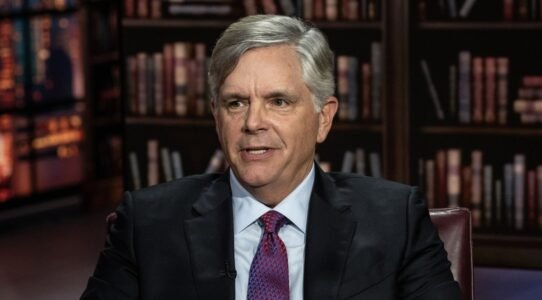
Vas Narasimhan’s first language was Tamil. He still remembers the strange feeling of knowing perfectly well what something was called in one language and not knowing how to say it in the language his classmates spoke. He grew up in Pittsburgh, when the city was still strongly shaped by the steel industry, the son of two Indian immigrants from small farming villages in southern India. His mother was a nuclear engineer at Westinghouse while also raising three boys. His father started at the bottom at Hoeganaes Corporation and eventually rose to the top of the company. Narasimhan often says that he did it by betting on himself again and again: he would resign, go back to school, earn another degree and start over.
Two ideas from that home still appear when he talks about the way he works. One came from his mother, who whenever she took him back to India would ask him more or less the same question: you had opportunities most people never had, what are you going to do with them? The other was much shorter, almost a family motto: stay in the ring.
Narasimhan studied at Harvard Medical School and for quite some time seemed headed toward a very different life. He worked with the Red Cross in Gambia, spent time in Kolkata with street children and victims of child labor —it was the first trip he took with the woman who would later become his wife, when they had been dating for only three months— and participated in Botswana’s first HIV treatment program.
It was precisely that experience that eventually drew him toward business. In public health, he saw many extraordinary people doing their jobs, but also poorly managed organizations and excellent doctors who suddenly found themselves leading teams without anyone ever having taught them how to do it. He wanted to understand that part.
He spent less than two years at McKinsey. When he arrived, he did not even know how to read a balance sheet, and he still remembers those months as having to learn a new language.
He joined Novartis in 2005 and has been its CEO since 2018. Today he leads a pharmaceutical company with more than 77,000 employees, operations in roughly 120 countries and medicines that reached more than 300 million patients in 2025. This year he also added a role that, at first glance, seems fairly removed from the pharmaceutical industry: he joined the board of Anthropic, one of the companies at the forefront of the artificial intelligence race.
The decision that looked like a mistake
In 2006, after two years at the Basel headquarters, he asked to be transferred to the vaccines division that Novartis had just acquired. The business was losing money and accounted for barely 2 percent of the group’s sales. If someone looked only at the organizational chart, it was difficult to see the move as a promotion.
Narasimhan remembers it instead as one of the best decisions of his career. In a smaller unit, there were fewer people to divide the work among and, as a result, much more fell on each person. He found himself handling clinical programs, development and commercial launches at the same time. He was learning several parts of the business at once.
What looked like a detour ended up occupying eight years of his career. And well before that period was over, when he had not yet turned 32, he was already sitting before the United States Congress explaining himself over the H1N1 pandemic.
To be clear: he had not been invited there to be congratulated. He had been summoned.
The summer when he could not deliver
Narasimhan had participated in the negotiations that ultimately made Novartis one of the main vaccine suppliers to the U.S. government during the swine flu outbreak. The company won the contracts. It then discovered that promising the doses was one thing and producing them on time was something very different.
That summer they failed to meet the first deliveries.
Narasimhan does not try to soften the story when he tells it. They had signed contracts with more ambition than capacity and had put the reputation of the entire company at risk. He had to explain it before Congress, to his own bosses and during a call with the White House chief of staff.
Then he went to the plants. He spoke with the teams, took part in meetings with operators and kept telling them that they could still deliver. Eventually, they did.
What stayed with him was less the final result than everything that happened before they reached it.
Dublin, Ryanair and eighteen months of fires
In 2014, Novartis sold its vaccines division to GSK and Narasimhan was left without a particularly clear place in the new structure. He was sent to the generics business in Germany. Five months later, he was put in charge of drug development. Three years after that, he was told he would become CEO.
He found out during a board meeting in Dublin. He stepped out to call his wife and tell her. She was in a meeting and hung up.
Then he went to the airport and spent twelve hours stranded there waiting for a Ryanair flight. He had just been told that he was going to run one of the world’s largest pharmaceutical companies, and he was sitting in an airport waiting for a low-cost flight to leave.
The amusing part of the story ended there.
During his first six months at the head of Novartis, problems surfaced everywhere. The 1.2 million dollar contract with Michael Cohen’s consulting firm, signed before Narasimhan took office, came to light. The SEC and the Department of Justice were investigating the company’s activities in Greece. There was another investigation into commercial practices in Asia. And in 2019, the FDA became involved over manipulated data linked to a gene therapy.
His first reaction, he now admits, was to distance himself from those events: all of it had happened before he took the job.
He later understood that this was a useless defense. A CEO does not manage only the decisions made from the day he sits down in the office. He also inherits the earlier ones, both good and bad. If the company was his responsibility, its problems were his as well.
Those first months also left him with a fairly concrete way of thinking about leadership. Someone running a large organization, he says, has to act as a shock absorber. A certain amount of pressure inevitably reaches the top, but not all of it can keep flowing downward. If every problem, every fear and every urgency experienced by the CEO ends up falling on the teams below, at some point the organization stops functioning well.
Some of that pressure, he argues, simply comes with the job.
Ten thousand jobs
The hardest decision came during the pandemic. Novartis eliminated more than 10,000 jobs, more than 10 percent of its workforce.
For Narasimhan, this was not an abstract restructuring viewed from a distance. He had spent much of his career inside the company and lived in Basel, a relatively small city where he even knew parents of his children’s classmates who worked at Novartis.
He spent a great deal of time trying to explain why he believed it had to be done. The company was going to focus on innovative medicines, simplify its structure and cut pipeline projects that no longer fit that strategy.
Over the years, Novartis’s results ended up supporting much of that transformation. Narasimhan avoids using that as a retrospective justification. When he made the decision, he says, he had no way of knowing that it would work out.
Why he cries
Narasimhan says he cries every time one of the medicines Novartis is working on successfully completes phase III clinical trials.
He does not mean it metaphorically.
Some of those programs have been inside the company for a decade. He knows the people working on them, knows how many times they came close to failure and, above all, knows that the vast majority of drugs that begin the journey never make it that far.
When one does, it stops being a project inside a laboratory and begins to become a new way of treating a disease.
He talks about Kisqali for breast cancer and Pluvicto for prostate cancer, but there is another development that affects him differently: the first new malaria medicine developed by the company in twenty-five years.
Narasimhan once sat in a hospital in Tanzania watching children die from malaria. Novartis has distributed 1.2 billion doses of Coartem. For him, that part of the pharmaceutical industry has never become simply a matter of numbers.
The three filters
When he has to decide where to allocate money, people and time, Narasimhan always returns to three questions. The first is whether something is part of Novartis’s mission. The second is whether it is consistent with the commitments the company has made to the people who depend on it. The third is usually the most uncomfortable: whether Novartis is really the right company to do it.
A drug for a rare cancer may easily pass the first two filters and fail the third. It may be an excellent therapy and worth developing, but simply too small for a company with annual revenue of around 60 billion dollars. In that case, someone has to sit down with the scientists who worked on it and tell them that the project may be better off in the hands of a smaller biotechnology company.
Something similar happens with acquisitions. When Narasimhan talks about the roughly 9 billion dollars paid for The Medicines Company, or the acquisitions worth 4.4 billion and 2.1 billion dollars of two companies specializing in radioligand therapies, he focuses less on how much they might add to sales.
What he looks at is what the acquired company knows how to do that Novartis does not yet know how to do, and how much that capability helps deepen the areas in which the company has chosen to compete.
Mindset, movement, nutrition and recovery
For fifteen years, he has worked with a coach and organized much of his routine around four things.
The first is mindset: learning to observe his own thoughts and emotions without automatically reacting to them. The second is movement. He does not care too much what kind, as long as it is sustained. The third is nutrition, where he tries to ask himself a very simple question every time he eats: whether he is doing it for performance or for pleasure. He considers both answers valid. Eating without knowing why is not.
The fourth is recovery, and lately it has become the most important. He calls it the ultimate medicine.
There is no great secret to the method, and he himself acknowledges that there are no quick results either. The difficult part is repeating those four things for years, precisely because the benefits appear long after you begin.
What comes next
His wife has four Harvard degrees and is also the CEO of a pharmaceutical company. Narasimhan suspects they may be the only married couple simultaneously running two public companies.
When she took on her new role, the organization of their family life changed as well. He had to learn to more often take on the role of the parent in charge at home, and he now says that one of his priorities is supporting their two children as they begin university.
He has far fewer certainties about what he himself will do after Novartis.
He says a job like his can only be done by giving 200 or 300 percent, and he still does not know when the moment will come when he no longer wants to, or can, sustain it that way.
The question of what comes next makes him uncomfortable. And for someone who has an anecdote ready to explain almost every important decision in his life, it is striking that this time he does not have an answer.