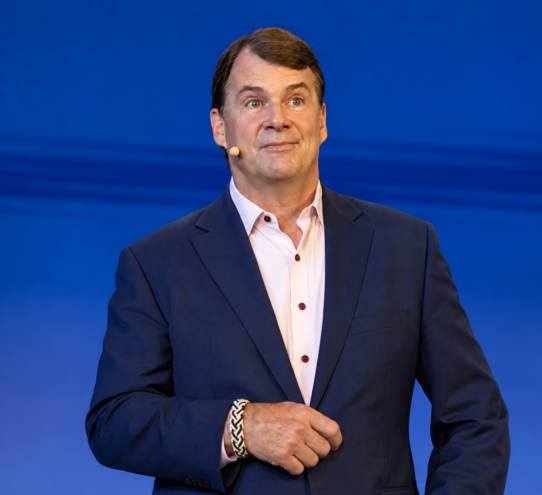





He took over GE when it was worth 96 billion dollars and close to the edge. Today, the three companies that emerged from it are worth a combined 689 billion dollars. His way of working, however, comes from much earlier: from a small family workshop in Maryland.
Larry Culp still keeps the payroll ledger from his grandfather’s workshop. It was a welding and machining business founded in 1938 in Silver Spring, Maryland, that grew to employ about a dozen people and was later run by his parents. Culp says he keeps the record because those numbers, small as they may seem today, represented the income of entire families.
That story helps explain a decision he made in 1990 that did not seem particularly logical to many of his classmates at Harvard Business School. Most new graduates wanted to join a consulting firm or an investment bank. Culp chose an industrial company.
He joined Danaher, which at the time manufactured hand tools. Three years later, he was already running his first business, a company that produced gauges for service-station tanks. He moved through increasingly larger units until 2001, when, at 38, he became CEO of the group.
He stayed for thirteen years. During that period, Danaher increased both its sales and its market value fivefold. When he left the company in 2014, he spent some time teaching at Harvard Business School.
In April 2018, he joined the board of General Electric. Six months later, he was named CEO. He was the first executive recruited from outside the company to hold the position in GE’s 126-year history.
The company he inherited had enormous debt, a corporate structure that had become difficult to sustain and a market capitalization that had fallen to 96 billion dollars. Culp began by selling assets, reducing debt and shrinking the corporate headquarters. Over time, he made a much bigger decision: to break up GE.
GE HealthCare went public as an independent company in January 2023. GE Vernova, which contains the energy businesses, followed in April 2024. What remained under Culp’s leadership was GE Aerospace, with about 57,000 employees and an installed base of nearly 80,000 commercial and military engines.
Today, the three companies are worth around 689 billion dollars combined.
The laboratory that flies
At the Farnborough International Airshow, Culp gave interviews with a GE Aerospace Boeing 747-400 behind him.
It was not the corporate jet.
That 747 is one of the company’s flying test beds. GE uses it to mount experimental engines and test them under real-world conditions before they reach an airline or aircraft manufacturer.
Bringing it to Farnborough also carried a message. In an industry where much of the conversation focuses on what the aircraft of the next decade will look like, Culp wanted to show how much work still goes into things that sound considerably less futuristic: making sure an engine is safe, reliable and capable of flying for thousands of hours.
Although the aircraft is equipped to test large widebody engines, it can also be adapted for other developments. Among them are the technologies GE is preparing for the next generation of single-aisle aircraft.
Sold out into the 2030s
Farnborough also brought orders. A lot of them.
Culp said it was the best air show of his career in terms of volume. The largest announcement was a multiyear agreement with IndiGo, the Indian airline, for more than one thousand engines.
The immediate question was whether GE Aerospace would need to buy more machinery and expand its factories to meet those commitments.
Culp adjusted the premise slightly. The company did not start preparing after the air show. It has been investing in its plants and suppliers for years because the production increase ahead does not depend on any single order. It stretches across several years and spans both commercial aviation and defense.
The phrase he uses to summarize it is simple: they are sold out into the early 2030s.
During the first half of the year, engine deliveries increased by more than 30 percent compared with the previous year. At the same time, the suppliers that had been constraining production the most have now grown at sequential double-digit rates for nine consecutive quarters.
For Culp, that matters because it shows that GE is not the only company investing. The businesses that have to supply the components needed to build those engines are adding capacity as well.
He does not expect that 30 percent growth to continue indefinitely. His calculation is more concrete: the second half of the year has to produce more than the first, and 2027 has to produce more than 2026.
You cannot fix the supply chain just by buying it
When asked whether GE will have to finance or acquire suppliers to secure deliveries, Culp does not give a single answer.
Some of the new capacity will come from investments inside the company itself. Some will come from working directly with suppliers to improve their operations. And in certain cases, there will be acquisitions. GE Aerospace has already bought several small companies that, according to Culp, could operate better as part of the group.
But Culp insists that buying a company does not solve a bottleneck by itself.
First, you have to know what is slowing production down.
It may be a machine, a poorly organized process, a shortage of workers, a component that takes too long to arrive or a decision nobody is making. If the problem can be solved by working with the supplier, there is no need to own it. And if the company is acquired without understanding where the constraint lies, ownership does not help much either.
What happens when oil prices rise
Oil prices put GE Aerospace in a somewhat unusual position.
When fuel becomes more expensive, airlines have more reason to replace older aircraft with newer, more fuel-efficient models. That benefits Boeing and Airbus and, by extension, increases demand for new engines.
But there is another side to it. If those same airlines retire older aircraft sooner, GE loses years of maintenance and spare-parts revenue from engines that are already in service. And aftermarket services are a very important part of the business.
Culp begins his answer with a phrase he repeats often: if something is good for Boeing or Airbus, it is good for GE as well.
Then he adds something he considers more important than the price of crude: how much people want to fly.
At Farnborough, he spoke with airline CEOs and had done the same weeks earlier at the IATA annual meeting in Rio. According to Culp, they all agreed that demand remained strong even after oil prices had risen since the Northern Hemisphere spring.
For GE, that means having work on all three fronts at once: new engines, maintenance of those already flying and defense.
Culp does not present that as a comfortable position. More as a long list of things the company has to be capable of delivering over the next several years.
Investing today in an aircraft that does not yet exist
One of the major topics at Farnborough was an aircraft that does not yet exist: the future replacement for the Boeing 737 and Airbus A320.
GE Aerospace is betting on an engine architecture known as open fan. The goal is to achieve a major improvement in efficiency while also simplifying certain parts of the engine and reducing maintenance costs.
Boeing and Airbus have not yet said which technology they will choose for their next generation of single-aisle aircraft.
That does not appear to make Culp anxious. The aircraft may be ten or fifteen years away, but that is precisely why the technical decisions have to begin much earlier.
If you wait until the manufacturer announces the aircraft before starting to develop the engine, you are already too late.
GE, together with Safran through CFM International, has already announced a flying test bed designed specifically to work on the new architecture.
Culp looks at the problem through the history of the industry. Every new generation of single-aisle aircraft has had to offer a clear improvement over the one before it. If the gains in fuel consumption, cost or performance are too small, it becomes difficult to justify investing billions of dollars in developing a new aircraft.
That is why he talks about an idea he borrowed from Jim Collins: the “genius of the and.” Rather than choosing between durability and efficiency, the goal is to achieve both.
The workshop before the boardroom
Culp has spent decades working with lean manufacturing and kaizen. He began at Danaher and continued when he arrived at GE.
He even brought some of the Japanese senseis he had worked with for years into General Electric plants to lead improvement sessions alongside the teams.
At GE Aerospace, that system eventually acquired a name of its own: FLIGHT DECK.
When Culp explains why the company was able to increase engine deliveries by more than 30 percent, he does not begin by talking about buying new machines. Machines are necessary, of course, and GE is investing in capacity. But for him, a factory does not produce more simply because it has more equipment.
Processes also have to change. People have to be trained. Downtime has to be reduced. Teams have to find where work is piling up, identify which component is arriving late and understand why. A visible problem has to stop recurring.
It is the same way he looks at suppliers. He does not begin by asking who owns what. He begins by asking where the work is getting stuck.
Decades after leaving the family workshop in Maryland, Culp runs a company with 57,000 employees and tens of thousands of engines flying around the world. He still keeps that old payroll ledger.
And when he explains how he runs GE Aerospace, he often ends up sounding less like a financial executive than someone standing in front of a machine trying to understand why it stopped.