




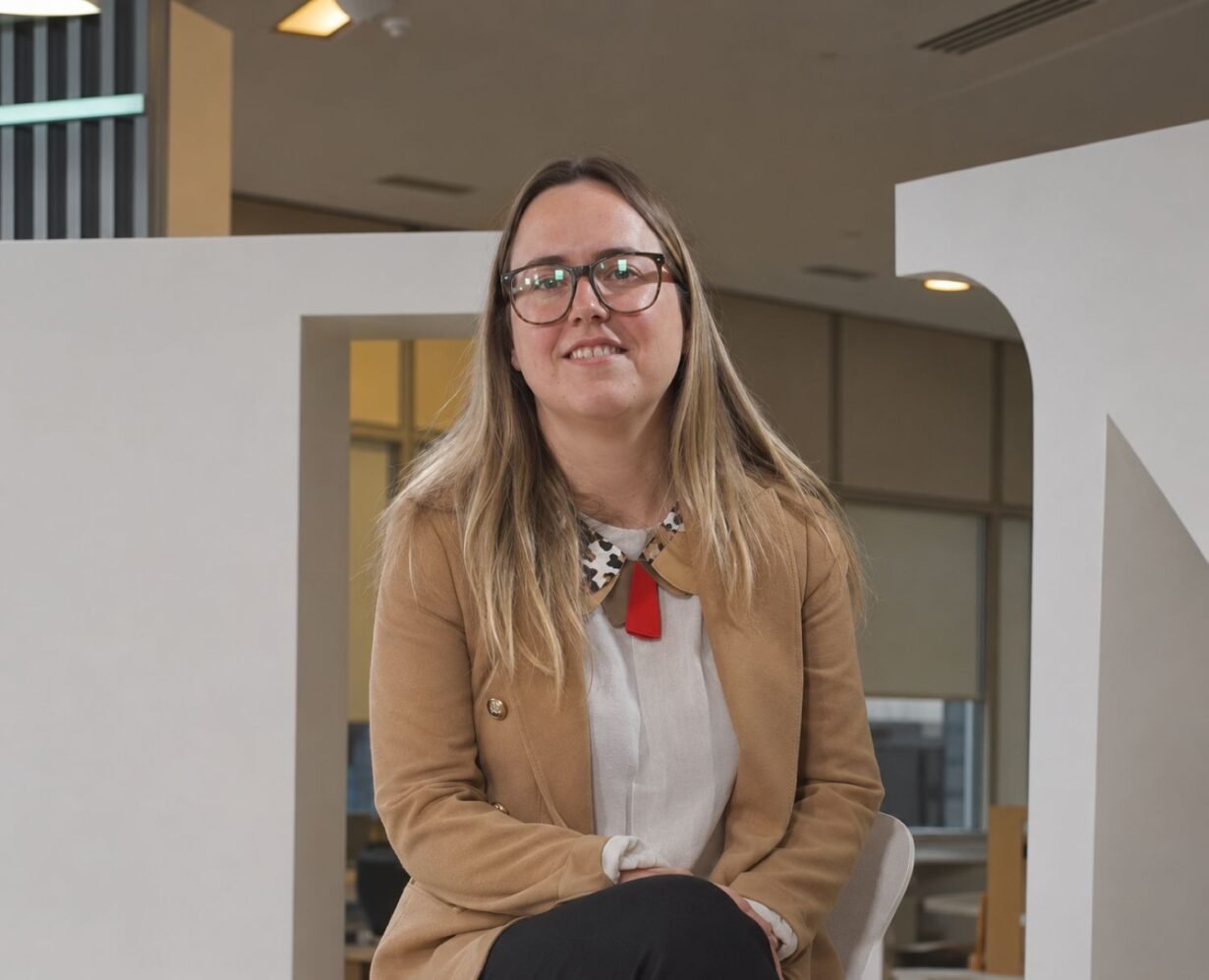
When Clemencia Nicholson moved from running Arbusta’s finances to leading the company, she already knew both sides of the business well. There were the clients hiring Arbusta for technology services and the young people joining the company for their first job in the sector. Today, some of those teams prepare and review the data other companies use to train AI systems.
Arbusta works with companies including Mercado Libre, Kavak, Despegar, PedidosYa, and dLocal. Between 2019 and 2024, its revenue grew from $1.9 million to $4.4 million. It has offices in Buenos Aires, Rosario, and Medellín and has received investment from the Swiss fund Elea and the US fund Potential Venture. Nicholson wants to triple the size of Arbusta’s regional operation. To do that, the company will need to bring in new clients and train more people on the job.
Getting a first job in tech
Paula Cardenau, Federico Seineldín, and Emilia Román founded Arbusta in 2015. They wanted to hire young people from underserved neighborhoods who had few opportunities to enter the technology sector. Many joined without a university degree or previous experience in the field. In its early years, the company offered training in those neighborhoods and gave participants a chance to learn by working on client projects.
Arbusta calls its approach to hiring la mirada de la posibilidad, or looking at what someone could learn. In practice, that means assessing what a person is capable of learning and giving them time to do it. The first assignments involved software testing and content management. Over time, the teams took on other tasks, including reviewing databases and labeling images and text to train models.
“We learned by doing,” Nicholson says. The same could be said of the company. Arbusta tried out different services, set up in Medellín, and added an operation in Uruguay in 2022. During the pandemic, it reorganized its work around data management and running business processes for clients, alongside the quality assurance services it had offered from the start.
From finance to the CEO role
Before becoming CEO, Nicholson was Arbusta’s chief financial officer. In that role, she had to work out how much each service cost to deliver and how much revenue it could bring in. Training people who were just starting out was part of that calculation. The company had to cover the cost of that training with what it charged clients.
Nicholson works alongside Pablo Mlynkiewicz, who leads technology, and Martín Senderey, who oversees operations. Together, they reorganized existing services such as data entry, data labeling, and software testing. Nicholson wants Arbusta to become a regional leader in data management. For clients, that can mean hiring the company for a one-off review or handing over an entire process.
What Arbusta does with data
The company describes itself as a “data refinery.” An example makes the term easier to understand. If a platform wants a system to learn how to spot irregularities, it needs to gather images and text, classify them, and check that the labels are accurate. Some of that work can be automated. Someone still needs to look at ambiguous cases and correct mistakes.
Arbusta says that, for a Mercado Libre project, its teams labeled images and text to train algorithms that went on to detect three times as many irregularities on the platform. In another project, for Kavak, Arbusta says it automated 70 percent of the data management processes covered by the assignment.
The company also verifies information to help prevent fraud, helps train AI agents, and monitors products and prices for online retailers. For that last service, teams compare what is being offered, at what price, and in which versions. Clients can use that information to decide whether to change a price or adjust their catalog.
What comes after Arbusta
Much of the work behind AI happens before anyone uses an application. Someone has to prepare the data, check how the system responds, and revisit the cases it gets wrong. At Arbusta, that work also gives people a way into the job market. A person might start by labeling data and, with experience, move on to reviewing other people’s work or taking on analysis and quality assurance tasks.
According to Arbusta, more than 700 young people who started working there have gone on to careers in Latin America’s digital sector. Nicholson tracks that number alongside revenue. It gives her a way to see what happens after people who joined with little or no experience start looking for their next job.
Growing as teams gain experience
Tripling the regional operation means winning new contracts and having teams that can handle them. At Arbusta, the time it takes to train people is part of that calculation. An assignment can grow from one month to the next, but learning to tell an error from a case that calls for a different interpretation takes practice and guidance from someone with experience.
That is one of the challenges Nicholson will face as Arbusta grows. Every new project brings deadlines to meet and data that someone has to review. It can also create a first job for someone who, under conventional hiring requirements, might never have made it to the interview.