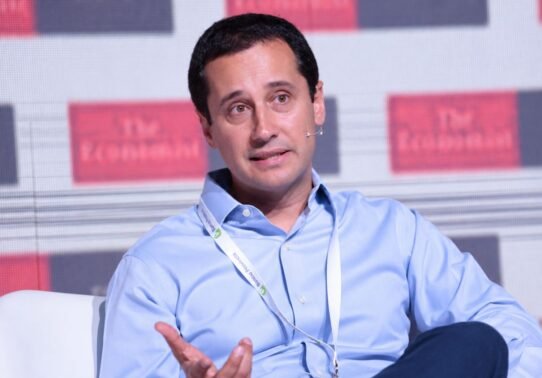





Franco Martínez Levis sells agricultural inputs made with microorganisms from the Puna’s salt flats. They live more than four thousand meters above sea level, with little water and scarce nutrients. For years, three scientists from CONICET studied how they managed to survive there. Today, some of those microorganisms are applied to soybean, wheat and cotton seeds.
The researchers are María Eugenia Farías, Elisa Violeta Bertini and Carolina Belfiore. They had been working for more than twenty years when they partnered with Martínez Levis to found Puna Bio. He came from consulting and startups, had pursued an MBA at Wharton and took on the task of turning those findings into a business.
The company was founded in Tucumán in 2020. Since then, it has secured more than ten million dollars in private investment, with backing from Corteva Agriscience and the Gates Foundation, among other investors. Its annual revenue exceeded one million dollars, and it is now seeking to triple sales.
Reaching that point took work. Besides functioning in the laboratory, the microorganisms have to withstand storage, survive transportation and reach the seed alive. Then they must deliver results in the field. And the economics have to work for the farmer.
Twenty Years Before the First Customer
Farías, Bertini and Belfiore wanted to understand how plants in the Puna grew in saline soils, with so little water and under intense ultraviolet radiation. They found that some microorganisms helped them withstand those conditions and make use of the available nutrients.
That led to a question with agricultural applications: could they do something similar for soybeans, wheat or other crops when water or nutrients were scarce?
Martínez Levis joined to work on that possibility. The partnership took shape with the participation of GRIDX, a fund specializing in biotechnology that was involved in creating the company.
When recounting its origins, he often dwells on the timelines. Puna Bio started in 2020, but much of the research dated back much further. By the time the search for customers and investors began, the scientists had already devoted two decades to understanding those environments and their microorganisms.
What Is Inside the Container
The work begins with samples of plants and soils from the Puna. In the laboratory, the microorganisms are separated, and the team studies what each could contribute to a crop.
Martínez Levis explains that thousands of bacteria and fungi coexist in a tiny grain of soil. The team must choose which ones to keep studying and check whether the promise shown in early tests holds up later. The candidates move from the laboratory to the greenhouse and, eventually, to the field.
Once the microorganism has been chosen, the team still has to determine how to produce it at scale and preserve it. Martínez Levis describes the formulation as a highly concentrated juice of microorganisms. It is applied to seeds alongside standard treatments, allowing farmers to incorporate it without changing their working methods too much.
According to Puna Bio’s figures, the company has around fifty people. Thirty-five work in science, and eighteen hold doctorates. The company maintains more than two thousand five hundred strains for research. It has also carried out more than six hundred field trials, with participation from INTA and independent specialists.
When Urea Prices Rise
Rising urea prices created an opportunity for Kanzama, Puna Bio’s product for wheat and barley. With fertilizers becoming more expensive, any improvement in nitrogen use deserves attention.
The company maintains that Kanzama supplies, through biological fixation, the equivalent of around thirty-six kilograms of nitrogen per hectare. Martínez Levis also highlights the microorganism’s ability to make use of different sources of that nutrient.
It can fix nitrogen from the air, help make nitrogen already present in the soil available, and contribute to the use of applied urea. Martínez Levis explains that having those alternatives reduces dependence on a process that requires a great deal of energy: obtaining nitrogen from the air. Having other pathways allows it to use different mechanisms throughout the crop cycle.
For the farmer, the explanation must be reflected in the numbers. Puna Bio estimates a return of between six and ten times the product’s cost. These are company estimates, subject to trial conditions and the circumstances of each field.
Three and a Half Years of Testing
Kunza, the biostimulant for soybeans, cotton and beans, has already been tested on more than three hundred thousand hectares, according to Puna Bio.
Developing its first biofungicide took three and a half years. The team evaluated fifty Trichoderma candidates before selecting one, which it then tested against fifteen pathogens. The company says it obtained results similar to or better than standard chemical treatments against the diseases known as damping off.
During that time, salaries had to be paid, trials conducted and microorganisms that failed to deliver the expected results discarded. Selecting one did not mean the product was ready either: a formulation that could be manufactured, preserved and sold still had to be developed.
In a company of this kind, those expenses arrive long before revenue from the launch.
Corteva and the Gates Foundation
Corteva Agriscience led the Series A round, in which the Gates Foundation participated as a minority investor. The amount of its contribution was not disclosed. Puna Bio also received support from the Bayer Foundation and recognition from the Falling Walls Foundation in 2024.
That financing makes it possible to sustain development and expand into other countries. Selling abroad requires registrations, testing and distribution agreements, each with its own timelines and costs.
The company reported activity in the United States, Brazil and Paraguay. It also has plans to reach Europe, Australia and Africa through partnerships.
The program with the Gates Foundation is aimed at smallholder farmers and family farming in Africa. There, the work includes ensuring that the product is affordable and can be used on farms with fewer resources.
Seeds That Arrive Already Treated
Martínez Levis wants seed companies to deliver seeds with the product already incorporated. That would spare farmers from having to apply it before sowing.
Puna Bio is working on that option. To offer it, the company must verify that the microorganisms remain alive and retain their effectiveness during seed storage.
At the same time, it is expanding its Tucumán laboratory and preparing a smaller facility in the United States. The company was projecting treatment of between three hundred thousand and four hundred thousand hectares in one growing season and doubling that area in the next.
Increasing sales requires producing more and delivering on time, but also closely monitoring what happens after application. Getting a farmer to try the product is a first step. Whether they buy it again depends on the result.