



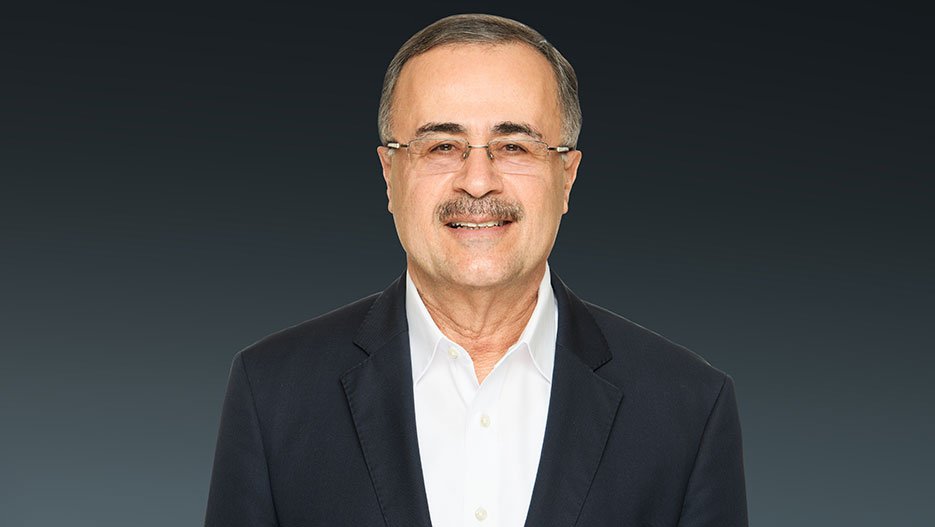
Amin H. Nasser, born in Saudi Arabia, serves as president and chief executive officer of Saudi Aramco, considered the largest oil company in the world and one of the companies with the greatest economic value internationally. Because of the relevance of his position, the Saudi executive has been one of the most influential figures in the global energy industry since 2015.
His figure gained worldwide relevance not only for leading Saudi Arabia’s main energy company, but also for his participation in global debates on energy security, the energy transition and fossil fuel production. Through his position and career, Nasser consolidated himself as one of the most influential voices in the international oil sector.
The Saudi executive began his career at Saudi Aramco in 1982 as a petroleum engineer, after graduating in Petroleum Engineering from King Fahd University of Petroleum and Minerals. He developed a career entirely linked to the energy sector and rose within the company’s technical and executive structure. During his early years, he worked in production, drilling and oil reservoir management areas, until reaching positions connected to exploitation engineering.
One of the most important moments of his career occurred when he became permanent CEO of Saudi Aramco in September 2015. Aramco carried out its historic 2019 stock market listing, considered one of the largest initial public offerings in the world, and deepened its expansion into petrochemicals, refining and natural gas. He also led the company’s response after drone and missile attacks against Saudi oil facilities in 2019, an episode that placed global oil supply at risk.
Career within energy and most relevant causes
He supervised one of the largest investment programs in the company’s history, aimed at expanding Saudi oil production capacity and consolidating the country’s global leadership in crude oil exports.
Under his responsibilities as CEO, he promoted a diversification strategy within Aramco. What happened? The company advanced investments linked to refining, petrochemicals and liquefied natural gas. One of the most relevant moves was the acquisition of a majority stake in SABIC, an operation considered strategic for integrating oil production and petrochemicals within the same industrial structure.
The Saudi executive became one of the most critical voices regarding international proposals. His relevance within the energy world rose exponentially. He consistently opposed the idea of rapidly abandoning oil and gas. In several international energy forums, he argued that an accelerated transition without sufficient infrastructure could generate inflation, to the point that in 2024 he declared that the “fantasy” of quickly eliminating fossil fuels should be abandoned, a phrase that generated strong worldwide repercussions within the climate debate.
What is his energy position based on? It is based on defending the need to maintain investments in oil and gas while new energy technologies are developed. He also promoted projects linked to emissions reduction, carbon capture and renewable energies within Saudi Aramco. Aramco announced multibillion-dollar investments in solar and wind projects, although it continued to keep oil as the main axis of Saudi Arabia’s energy business.
Nasser also played an important role during episodes of international tension that affected the energy market. His leadership during the attacks on Saudi facilities in 2019 and during later regional conflicts showed how Aramco became a central actor for the stability of the global oil market. He had to reorganize exports, redirect crude flows and sustain strategic operations to avoid global disruptions in energy supply.
The current role
At present, he continues to lead Saudi Aramco and maintains decisive influence within the international energy market. He is part of boards and councils of international academic, financial and energy institutions.
He represents a combination of corporate leadership and geopolitical weight, and has consolidated himself as one of the main defenders of the continuity of oil and gas as pillars of the global energy system.
What is Nasser’s warning to the world?
For years, Nasser has warned that the world faces a serious energy risk if it abandons investments in oil and gas too quickly without yet having alternatives capable of sustaining global energy demand. Nasser argues that there is a contradiction between international climate goals and the reality of global energy consumption. In his view, while many countries announce decarbonization targets, global demand for oil and gas continues to grow, especially in emerging economies in Asia, Africa and Latin America. Nasser managed to place a central discussion for the future on the agenda: how to balance energy security, economic growth and environmental sustainability in an increasingly complex international scenario.