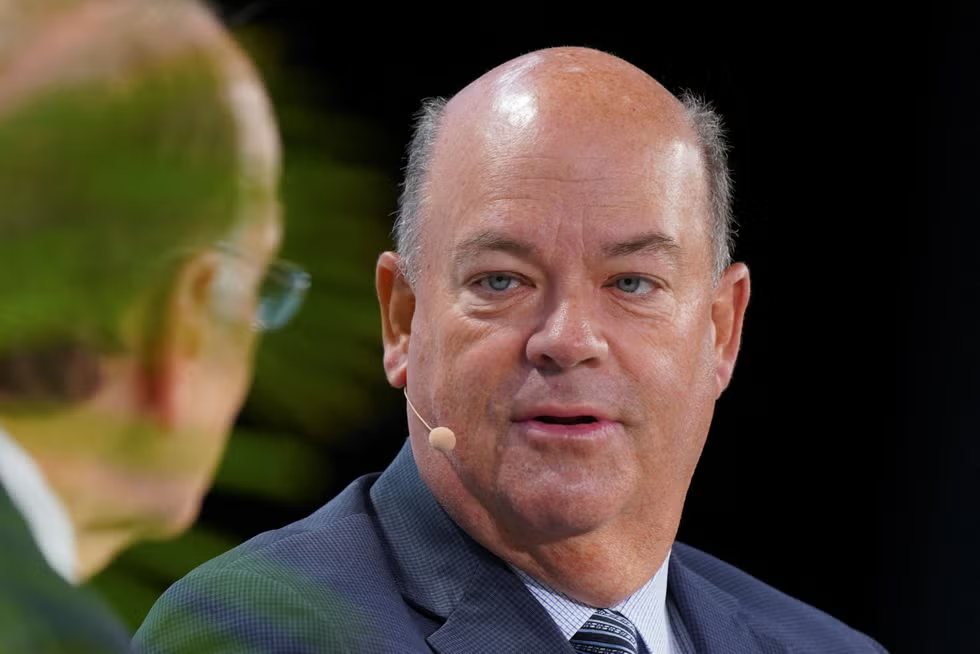


The CEO of YPF explained how he built the 4×4 plan, why he asked the company to sell its aircraft, how bonuses are distributed down to the last employee at a service station and what tennis taught him about running the country’s largest company.
There is a family story Horacio Marín repeats whenever he is asked where his way of thinking comes from, and it probably explains more about his management of YPF than any investor presentation.
His grandmother, an Italian immigrant, arrived in Argentina after spending years working the land alone in southern Italy. When the family finally had a home of its own, she walked into the bathroom, saw that it had only a latrine, came back out, looked at her four children and told them that, starting the next day, they were all going to work because they deserved a proper toilet.
“If she saw a need, she did not say that it created a right. She would have said that it created an opportunity,” Marín explains. He says that sentence shaped the way he looks at work.
From La Plata to Wimbledon
Marín was born in the Mondongo neighbourhood of La Plata. His father was an architect—the first generation of the family to attend university—and his mother had worked as a hairdresser since the age of eleven. In the 1970s, the city was a difficult place, and his father pushed him towards the sports club to keep him off the streets. That was where tennis appeared.
He was eleven when he stepped onto a clay court for the first time. That same day, he says, he decided he would play at Wimbledon. He told no one for seven years. At eighteen, he played there. “The day I played at Wimbledon, my legs were shaking,” he recalls.
And that was where, according to his own interpretation, he made the mistake he would later turn into a method: he fulfilled the dream but failed to set the next goal. Tennis stopped being a passion and became a source of pressure. He quit playing.
From that episode, he drew a rule that he imposed as an internal standard: at YPF, the word success is forbidden. “When you say success, failure follows as its opposite,” he explains. He replaced it with another word: improvement.
He studied chemical engineering at the National University of La Plata while teaching more than forty hours of tennis lessons each week and going to bed at one in the morning. He graduated with an average grade of 9.47 and achieved the highest mark in twenty-two subjects. He later completed a master’s degree in Petroleum Engineering at the University of Texas and postgraduate business studies at Stanford.
The three requests from his first day
When the board appointed him president and CEO, Marín arrived with three specific requests. The first was to sell the aircraft. His argument was blunt: private planes are for people with personal wealth, not for employees. “I have flown commercially all my life, and I arrive perfectly well.” The second was to present the company’s complete organisational structure himself, with a full name in every box. The third was the 4×4 plan.
He developed that plan in a month and a half, working before dawn. Once his appointment was confirmed, he stopped sleeping properly: he would wake up at 4:30 with his adrenaline surging. Instead of fighting the insomnia, he decided to use it. Every four days, he would collapse from exhaustion, sleep, and then begin again.
The 4×4—four pillars, like a four-wheel-drive tractor—now has, in his mind, the status of a registered trademark. “I will die saying YPF 4×4.” The reason for such insistence is not marketing: he argues that the company produces results because every department knows exactly what it has to do.
Bonuses for the person who pumps fuel
One of the changes he discusses most often has nothing to do with Vaca Muerta, but with the forecourt of a service station. Marín asked himself a simple question: if vice-presidents receive bonuses, why should the person who pumps fuel not receive one? A company’s excellence, he argues, is built by everyone, from the fuel pump to the clean bathroom. That was how the bonus known internally as the Marín bonus was created. The only person who does not receive it is Marín himself: he believes it would be unethical to request a bonus that he personally approves.
Following the same principle, the company shares 6% of sales of non-fuel products with service-station employees. That, he reveals, is why they now offer customers coffee or a hamburger while they refuel.
The same logic applies to operations. During a maintenance shutdown at the La Plata refinery, the person in charge told him it would take fifty days. Marín replied that he was thinking in terms of the old productivity levels and offered him a deal: double the bonus if the work was completed in twenty-five days. They finished in twenty-five days and seven hours. Those who worked on the shutdown received the equivalent of five monthly salaries as a reward. In two years, the refinery moved from the lowest quartile of global efficiency to the highest.
What, when and how
His management philosophy fits into a simple formula: the manager defines what must be done and when; the team decides how. He only intervenes in the how when he sees that the deadline will not be met. It is his antidote to micromanagement, which he considers the main cause of demotivation: when a manager dictates every step, employees stop contributing the only thing they truly bring—their knowledge.
He also introduced an internal distinction regarding mistakes: negligence is grounds for dismissal, but taking a risk that produces an adverse result is not. When nobody is allowed to make mistakes, nobody does anything.
His Mondays begin at seven. At eight, there is a two-hour LNG meeting, without exception. Afterwards, he meets with his sixteen vice-presidents, all together and in person: decisions improve, he says, when someone listens to another person and changes their mind during the discussion. At weekends, he reads a sixty- to seventy-page report delivered on Friday night.
The glass ceiling
Under his management, YPF signed agreements with Tesla to install Superchargers at its service stations, with McDonald’s to open new outlets and with Mercedes-Benz for first fills and lubricants. The McDonald’s agreement has its own story: when the franchisee asked him what mattered most at a service station, Marín answered without hesitation that the bathrooms had to be clean. They closed the deal on the spot. The announcement alone increased monthly hamburger sales from 600,000 to 900,000.
Behind all this lies a conviction: “YPF is enormous. The problem is that Argentines do not realise it.”
The achievement he is most proud of, however, is cultural. An executive whom he had pushed hard for months eventually thanked him. He said Marín had broken through his glass ceiling and that he was achieving things he had never believed possible. For Marín, that captures everything. “I do not have his knowledge. What I need is his knowledge and his desire to break through glass ceilings.”
He knows exactly when his cycle will end: 2031. He has not taken a holiday since assuming the role. And he knows how he would like to be remembered: “The day I leave, what I would most like people to say is that a true YPF man has left.”