



The CEO of Schneider Electric is the industrial partner behind France’s biggest investment announcement: SoftBank’s $75 billion commitment to data centers. And yet, at industry summits, he keeps saying that no one is properly calculating how much energy all of this is going to require.
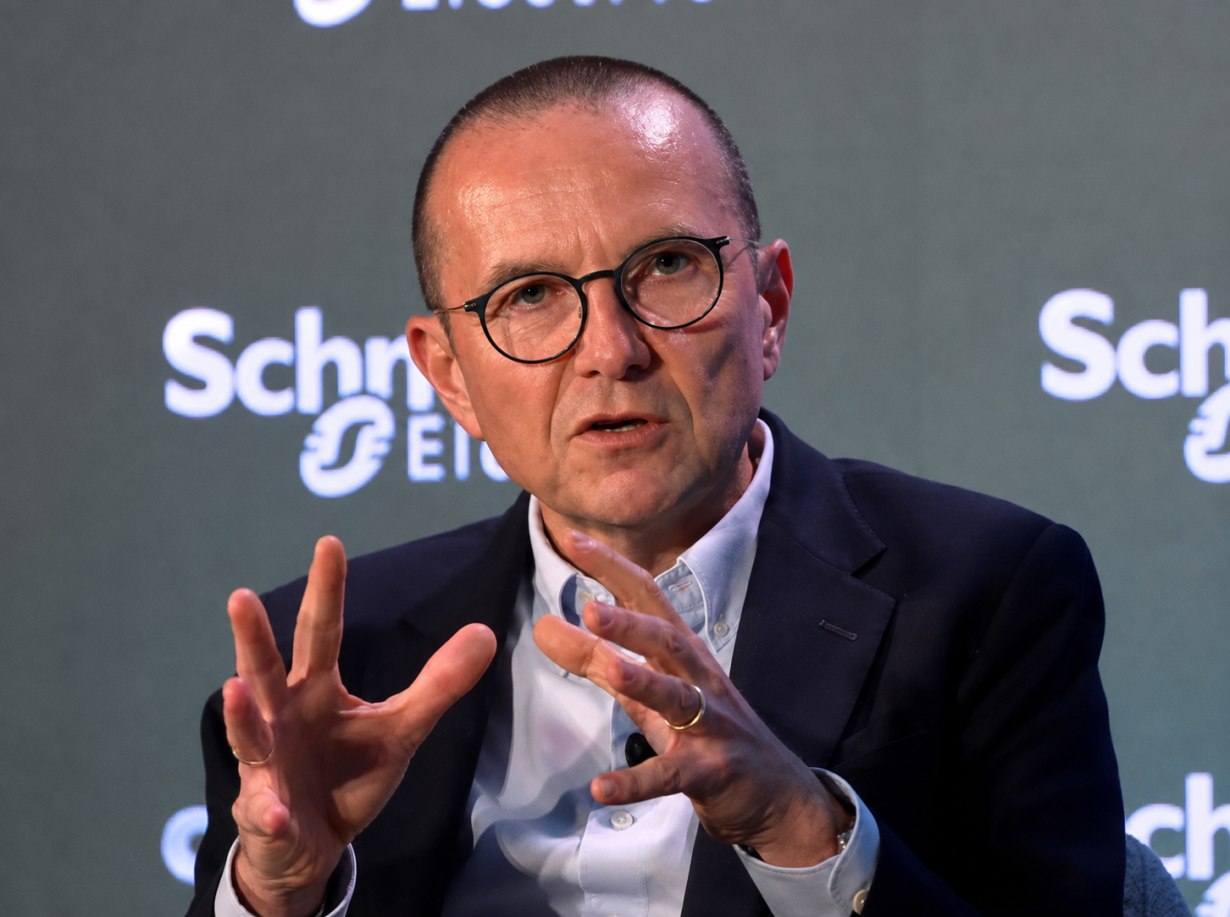
At a technology summit in India, after days of talks about how artificial intelligence was going to transform everything, Olivier Blum took the stage and said what had been missing.
He said he had learned a great deal and met many valuable people, but had not heard enough about energy or about the need to make it much smarter if the world really intends to sustain what is coming.
Coming from almost any other speaker, it would sound like a routine observation. Coming from him, it means something else: Schneider Electric is one of the companies benefiting most from the construction of data centers.
The numbers do not add up
The argument he brought into that room is purely numerical.
Current projections estimate that the world will need about 10,000 additional terawatt-hours of electricity between 2024 and 2035, and another 12,000 through 2050. That calculation already includes the growth of electric vehicles, heat pumps and much of industrial electrification.
Blum points out that those scenarios do not include artificial intelligence, adding further pressure to a system that is already stretched.
On the data center side, the scale is also growing quickly. By 2030, estimates suggest that more than 200 gigawatts of capacity will need to be added, with roughly half of it linked to the expansion of artificial intelligence.
80, 150, 1,000
The pressure is easier to understand through an engineering figure than a macroeconomic one: how much electricity a rack consumes, the cabinet where a data center’s servers are concentrated.
Only a few years ago, a rack consumed a few kilowatts. Then it rose to ten, twenty or thirty, while the ones Schneider builds today in India are around 80 and those being installed in the United States with Nvidia processors are already reaching 150. Blum believes the next jump will be much larger and, together with Nvidia, talks about a range of 500 kilowatts to one megawatt per rack.
At that point, adding more cables is no longer enough. The entire electrical architecture also has to be redesigned, with 800-volt direct current emerging as a new standard.
The electrical panel in your house
His answer to that problem is not only about generating more electricity, but about consuming it better. He explains it with a domestic example.
Every house has an electrical panel and, almost certainly, it is not connected. If it were, data could be extracted, an artificial intelligence agent could manage consumption, and electricity use could be reduced by between 10% and 30%. He is testing it in his own home and says it works well, but what gives the example real weight is that residential use represents the largest source of electricity consumption in the world.
Behind that position is a decision Schneider made a decade ago. After the 2015 Paris Agreement, the company decided that all of its products should be able to connect and generate data. While much of the energy debate focused on producing more clean power, Schneider chose to work on consumption and efficiency.
Blum acknowledges that the process was harder than they had expected, with resistance from grid operators and companies unwilling to move their data to the cloud. He also admits something more uncomfortable: the technology was not ready. His assessment after ten years is that they have barely scratched the surface.
Dunkirk
In France’s biggest recent investment announcement —SoftBank’s $75 billion commitment to data centers in the north of the country, with a first tranche of $45 billion through 2031— Schneider became the industrial partner. It designs and optimizes the facilities and supplies the equipment installed inside them.
The concrete development is a factory in Dunkirk, next to the future data center, where Schneider will produce prefabricated modules built as integrated blocks that can be installed at once instead of assembled on site. The objective is to save time.
To understand the scale, all of France had 1.5 gigawatts of installed data center capacity at the end of 2025, while this project alone is expected to reach between 3 and 5.
Blum explains the choice with a list that is not particularly patriotic: you need an investor, a location with available land and fast permitting, a supportive government and immediate access to decarbonized energy. On permits, he allows himself some irony, since France is hardly famous for moving quickly.
The one selling the shovels
The obvious question in that context is whether all of this is a bubble. Blum usually answers in the same way, and never through valuations.
His first argument comes from customers. Schneider speaks with the 200 largest players in the world, which share their plans for the next twelve, twenty-four and thirty-six months. With that information in front of him, he does not see a bubble.
The second argument is about Schneider itself, and it is more interesting. He says his own company currently uses less than 5% of the artificial intelligence it expects to use five years from now. If the company building the infrastructure is still barely using the technology, he reasons, the cycle is only beginning.
As another reference point, he notes that data centers currently account for around 1.5% of global energy consumption and are heading toward 3%.
What is not balanced
There is another side to the story.
Data centers already account for close to 25% of Schneider’s business, and Blum responds that the company remains balanced, with strong growth in semiconductors, power grids and industry, as well as broad geographic exposure. But he admits that concentration is something he always worries about.
There is also an imbalance he does not dispute. When a journalist pointed out that Schneider’s growth in manufacturing systems for artificial intelligence in the United States is heading toward roughly $700 million by 2027, compared with only $110 million in Europe, he did not challenge the figures. Instead, he redirected the answer, saying that Europe has started to move, that France is an example, and that many more projects like Dunkirk are needed.
Twenty years
There is a symmetry in the story that Blum likes to point out.
He arrived in India in 2007 as Schneider’s country director and found an economy whose main problem was access to reliable electricity.
Almost twenty years later, now as global CEO, he argues that the problem is no longer unique to India and now affects the entire world, including the United States. And he warns that the real energy demand created by artificial intelligence has not even arrived yet.