



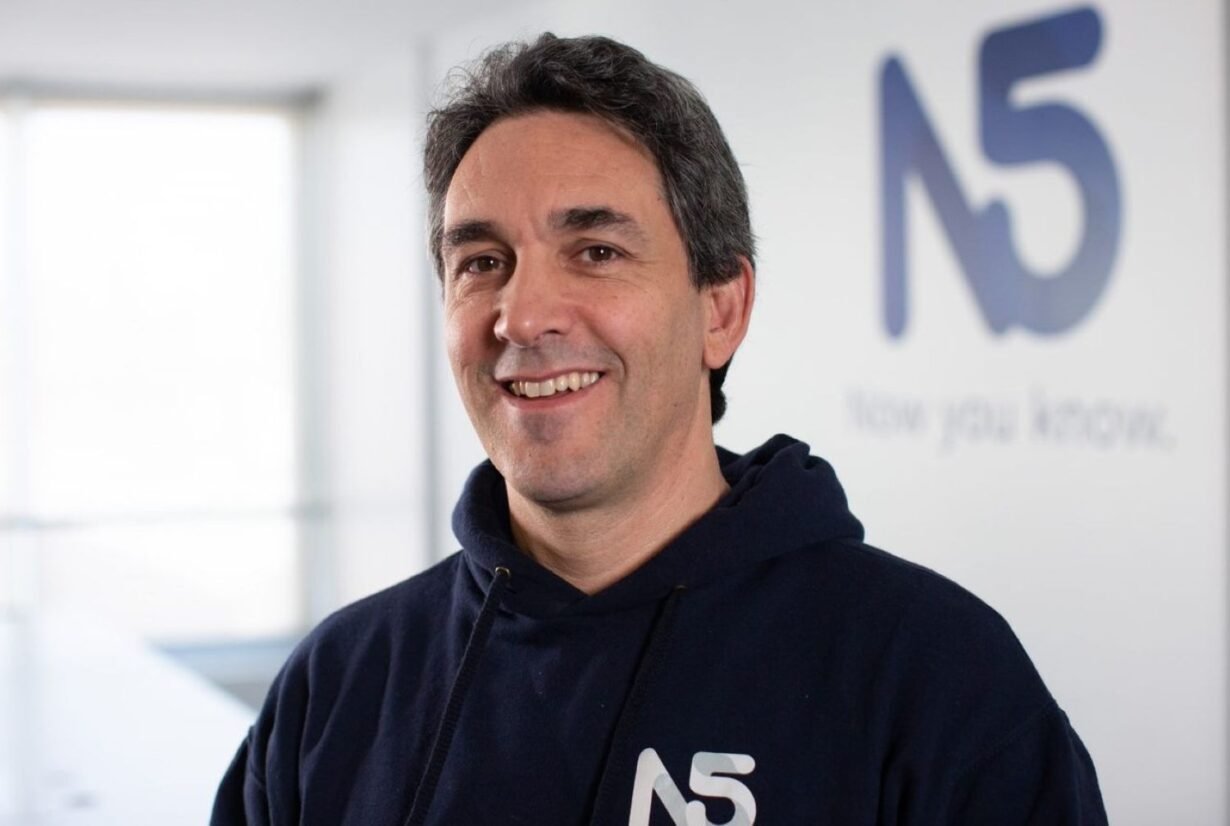
For three years, Julián Colombo crossed the Atlantic roughly fifty times a year, flying back and forth. He left São Paulo at midday on Sundays and returned from Madrid on Thursday nights. Fridays were his only normal day: the day he could pick up his son from school.
One Friday, his six-year-old climbed into the car, thrilled. He had wonderful news.
“Dudu’s dad works at a bank, but that bank is in Brazil. So he can pick him up every day.”
That was when, Colombo says, he emotionally checked out. It took him another thirteen months to follow through.
When he did, he moved quickly. On a Thursday, he said goodbye to the bank in Madrid after two decades. On Friday, he registered a company in the United States and deposited his only investment: 100 dollars. By Monday, he was in Panama, spending eight hours talking with Max Harari, the owner of Credicorp Bank, a man he had never met in person. He left with a check for 5.2 million dollars in advance license payments for a product that did not yet exist.
That morning, he had a company without money. That afternoon, he had money without a company.
From the branch to the management committee
Colombo studied Economics and Journalism. He wanted to be the guy who explained economics on television. To fit both degree programs into his schedule, at twenty-two he took the most accessible job he could find: commercial assistant at a Banco Río branch at Florida and Lavalle. The lowest position available.
He was not equally good at everything. As a substitute teller, he jokes, he was the South American champion of counting banknotes slowly: by the time he finished paying a customer who had come to withdraw her fixed-term deposit, she had earned two more days of interest.
Two things happened that he had not expected. He fell in love with the bank, and the bank loved him back.
Money was a distant subject in his middle-class household. At twenty-five, he called his father—a university professor and the family’s first accountant—to tell him about a discovery: banks offered something called a bonus, a payment on top of a salary. His father thought he was talking about dividends. Decades later, after twenty years living abroad, those bonuses had become the main component of his wealth.
From the branch, he moved into risk management, just as credit scoring was arriving. In 2001, at a little over twenty-five, he experienced Argentina’s banking withdrawal restrictions, known as the corralito, from the inside: entire mornings spent interpreting Central Bank resolutions to work out how to open the following day.
Then Santander—which had acquired Banco Río—sent him to Spain to help build a unified brand. He worked in fourteen countries, lived in six and reached the group’s commercial management committee as its only member who had started in a branch. His final salary was 131 times his first.
Along the way, having been assigned to headquarters three times, he wrote a paper in 2010 that he called Cognitive Banking. It was too theoretical: the world lacked the computing power and generative artificial intelligence it required. He put it away.
The turning point
Emilio Botín died on September 10, 2014. At that moment, Colombo understood that his dream—to become the group’s CEO after starting in a branch—was not going to happen.
Salesforce tried to recruit him. At a meeting in San Francisco, they told him he should leave the bank and develop that software for every bank in the world. On the flight home, he decided two things: he was leaving, and he would do it on his own.
The bank offered another way out. If he stayed until fifty, he could take early retirement with 70% of his salary for life. He was forty-four. Six years remained.
He did not wait.
A remote company before remote work took hold
After years away from home, Colombo decided his company would not repeat that arrangement: nobody on his team would lose two hours to traffic, and everyone would be able to take their children to the doctor or attend a school event. He built a remote company when the model was still uncommon. One digital bank even told him it could not buy from “a ghost company,” because it needed to audit offices and his employees worked from home. Eighteen months later, during the pandemic, that same bank invited him to give a talk about running a modern company.
Today, his office occupies the upper floors of his home in São Paulo. He works until eleven at night, but at six he goes downstairs to have dinner with his wife and their three children, born in Spain, Chile and Brazil. In eight years, he says, he has spent only three weekends away from home.
The miracle industry
On its first day, N5 was an administrative puzzle: tax residence in Spain, a company in the United States, a client in Panama, a home in Brazil and a first employee in Argentina. Within six months, it had clients in England, the United States, Spain and Brazil. B2B sales, he says, are like a jar of olives: pull one out, and the rest follow.
During those eight hours with Harari, Colombo made a promise: within five years, banks such as Citi and JPMorgan would be among his investors, and some of the world’s largest companies would be his clients. He also assured him that whenever he told N5’s story, he would say that Credicorp, Panama’s best bank, had supported them when doing so was difficult. All three things came true.
Today, N5 develops software for financial institutions. Its clients include Mastercard, Santander and Itaú, as well as seven of Latin America’s ten largest banks. Banks such as Citi and JPMorgan are among its investors. Ninety-seven percent of its revenue comes from outside Argentina.
His thesis grew out of a painful experience: banks suffer from an excess of software rather than a shortage. He calls it technological entropy. Santander once had 72,000 active software programs in its inventory, and a typical bank spends 91% of its technology budget keeping the plane flying. One client eliminated fourteen suppliers and twenty-nine products by using his platform.
The company also applied its own approach internally: with artificial intelligence, it went from 323 employees to just over 150, spread across eighteen countries, while continuing to grow.
The paper he put away in 2010 also found its moment. When the computing power and generative artificial intelligence became available, N5 was the company best prepared to build what Colombo calls an autonomous banker: a system capable of managing a portfolio, allocating capital, negotiating risks and setting prices.
Colombo says he invested 100 dollars in a company now worth 100 million, the best investment multiple of any fund in the world. He also says he still has 90% of the journey left before becoming a unicorn.
He insists both things are true, and that he always says them together.