


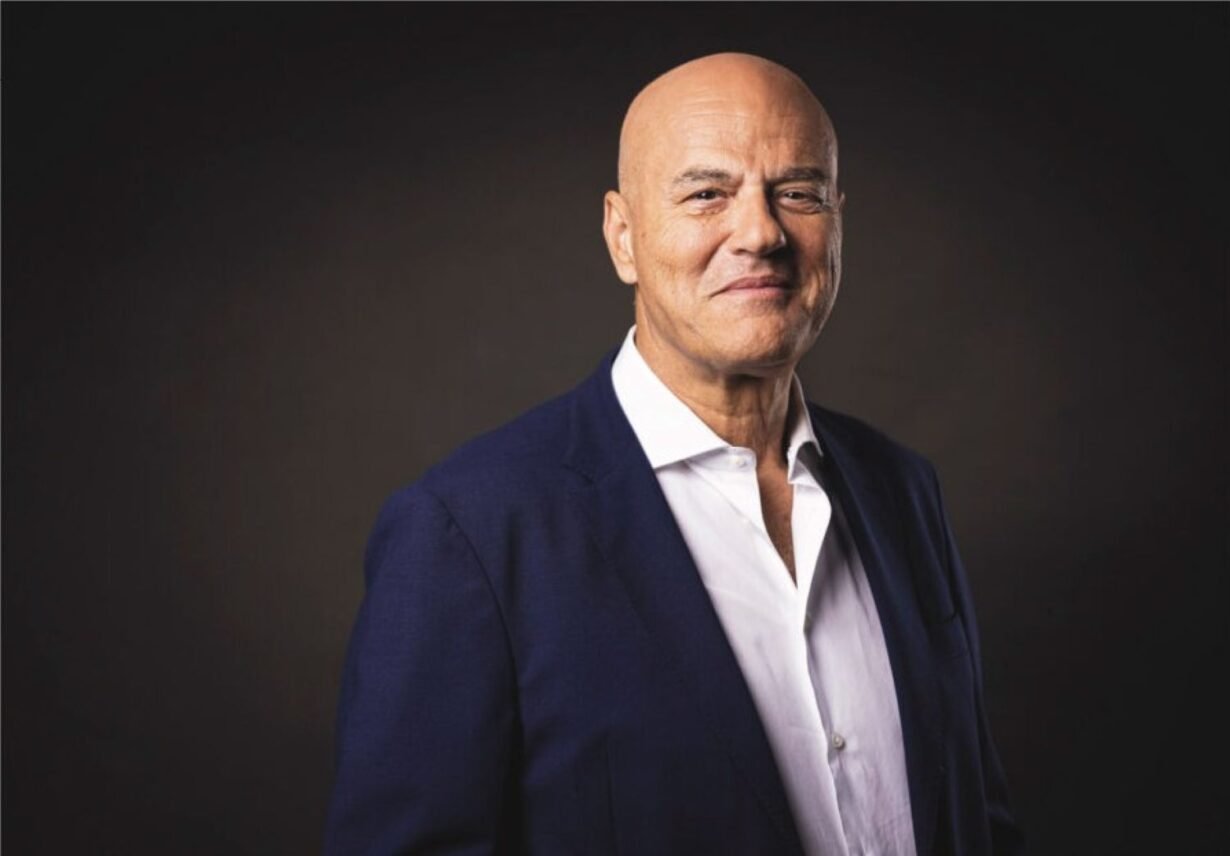
The Milan-born physicist who joined ENI in 1981 as a reservoir engineer and has led the company since 2014 is now presenting a new plan looking toward 2030, with more exploration, an extraordinary dividend tied to oil prices, and a long-term bet on Argentine LNG alongside YPF.
Analysts wanted to measure how much the war could hurt the business, from ships crossing the Strait of Hormuz to the share of production that would be exposed if the conflict escalated.
Claudio Descalzi first answered with the numbers, since between 2% and 3% of production was exposed and there were no stranded cargoes, but then he insisted on an idea he repeated twice during the conversation: ENI had never been stronger.
It is the kind of statement any CEO might make during an investor presentation. The difference is that this one has spent forty-five years at the same company and knows quite well what the business looks like when it is not strong.
Descalzi was born in Milan in February 1955 and graduated with a degree in physics from the university in his hometown in 1979. Two years later he joined ENI as a reservoir engineer and has spent his entire career at the company ever since. For many years, however, his path was more closely tied to the field than to the office, working as a project manager on operations in the North Sea, Libya, Nigeria and the Congo. In 1990 he moved on to manage operational and reservoir activities in Italy, four years later he took charge of the Congolese subsidiary, and in 1998 he assumed responsibility for operations in Nigeria. Between 2000 and 2005 his responsibilities expanded to Africa, the Middle East, China and Italy, until that last year, when he was appointed deputy general manager of exploration and production. In 2008 he became chief operating officer, a position he held until taking the helm of ENI in 2014.
In May 2014, he became the company’s top executive and remains in the position.
In 2012, he became the first European in the sector to receive the Charles F. Rand Memorial Gold Medal, awarded by the Society of Petroleum Engineers and the American Institute of Mining Engineers. Outside ENI, he also maintains academic and cultural activities as a visiting fellow at Oxford and president of the foundation of Milan’s Teatro alla Scala.
Since 2014, ENI has discovered more than 11 billion barrels of oil equivalent, averaging close to 900 million a year and at a cost of around one dollar per barrel. The discoveries were spread across more than twenty countries.
Last year, the reserve replacement ratio reached 167%, the highest in the sector, and under its plan through 2030 the company aims to maintain an average above 140%.
Descalzi attributes those results to a decision made more than a decade ago: concentrating exploration close to facilities that are already operating. That reduces risk and costs and shortens the time between a discovery and the start of production. The strategy allows ENI to sustain growth efficiently. For this year, the company projects gross investment of €7 billion, 18% less than in 2025.
Last year it found oil in Namibia, Indonesia, Angola and Norway. This year began with new discoveries in Angola, Ivory Coast and Libya that together exceed 400 million barrels.
Argentina
In Argentina, ENI partnered with YPF and XRG to develop a large-scale liquefied natural gas project. The plan calls for production of close to 1.8 billion cubic feet of gas per day and annual LNG exports of 12 million tonnes from two floating plants. That would be joined by around 200,000 barrels per day of liquids from shale, while the final investment decision is expected this year and first production is scheduled for 2030.
Descalzi bases the Argentine bet on experience ENI has already been building. The company operates three floating liquefaction plants in Mozambique and the Congo and has another under construction. The idea is to apply that expertise to Vaca Muerta gas and bring it to international markets at a competitive cost.
It has also added exploration in Uruguay, again alongside YPF.
Within the plan through 2030, Argentina still has limited weight. Most of the growth expected from the country comes later, in the following decade.
Another feature of Descalzi’s management can be seen in the way the group organizes its companies and equity stakes.
Instead of keeping everything on its balance sheet, ENI separates businesses, brings in financial partners and allows them to grow with their own capital.
Plenitude, the renewables and customers unit, has 5.8 gigawatts of installed capacity and 10 million users, and by 2030 aims to bring both figures to 15. Its reorganization is based on an equity valuation of €10.75 billion and a €1.5 billion capital increase, after which ENI deconsolidates the business but retains around 65% and joint control. Enilive, the biofuels unit, aims to triple its biorefining capacity.
Together, the two businesses are already valued at more than €23 billion and ENI expects them to generate around €5.5 billion in operating profit by 2030. Since 2018, these businesses have contributed €15 billion in cash to the parent company, and ENI estimates they could add another €16 billion over the next five years.
Ninety dollars
The financial novelty in the plan is a mechanism none of its peers currently has.
Until now, when conditions improved, ENI distributed 60% of the excess through share buybacks and continues to do so, but it added a new threshold: if the average Brent price exceeds $90 during the year, 100% of the cash flow generated above that level will be distributed as an extraordinary dividend. The same mechanism is triggered if gas prices or refining margins exceed forecasts by more than 50%, with an assessment in the third quarter and payment in the fourth.
The explanation is practical and not particularly glamorous: at a certain scale, buying back shares stops being efficient because there is a physical limit to how many can be purchased each day.
The 2026 dividend will be €1.10 per share, 5% more than last year, while the buyback starts at €1.5 billion and could rise to €4 billion depending on the cash flow generated during the year. Net debt ended at 14%, a historic low for ENI, which aims to remain within a range of 10% to 15% over the coming years.
Not everything is working, and it is worth saying so.
Chemicals remain the weakest point. Demand has stagnated and input costs have risen, pushing the operating break-even point back by two years. With new measures, the company expects to cut that delay to one.
The deconsolidation of Plenitude improves leverage by four percentage points, although it also reduces this year’s operating cash flow by around €400 million. That impact partly explains why ENI decided to increase the distribution range for shareholders.
In that context, Descalzi prefers not to play at guessing. When asked which price could break first, his number two replied that conditions change so quickly that any ranking can become outdated within hours. He therefore asked investors to treat his answer as a snapshot of that particular moment.
After 2030
The prospect that excites him most lies outside the plan.
ENI is a strategic partner and the main investor in the private company leading the race toward nuclear fusion. Descalzi describes it as a technology that will play an important role in the energy sector, but he does not put a date on it.
The fusion bet also fits with his way of thinking. After a career devoted to shortening the time between discovering something and producing it, he is now placing a bet on a technology that still has to prove it can work at scale.