



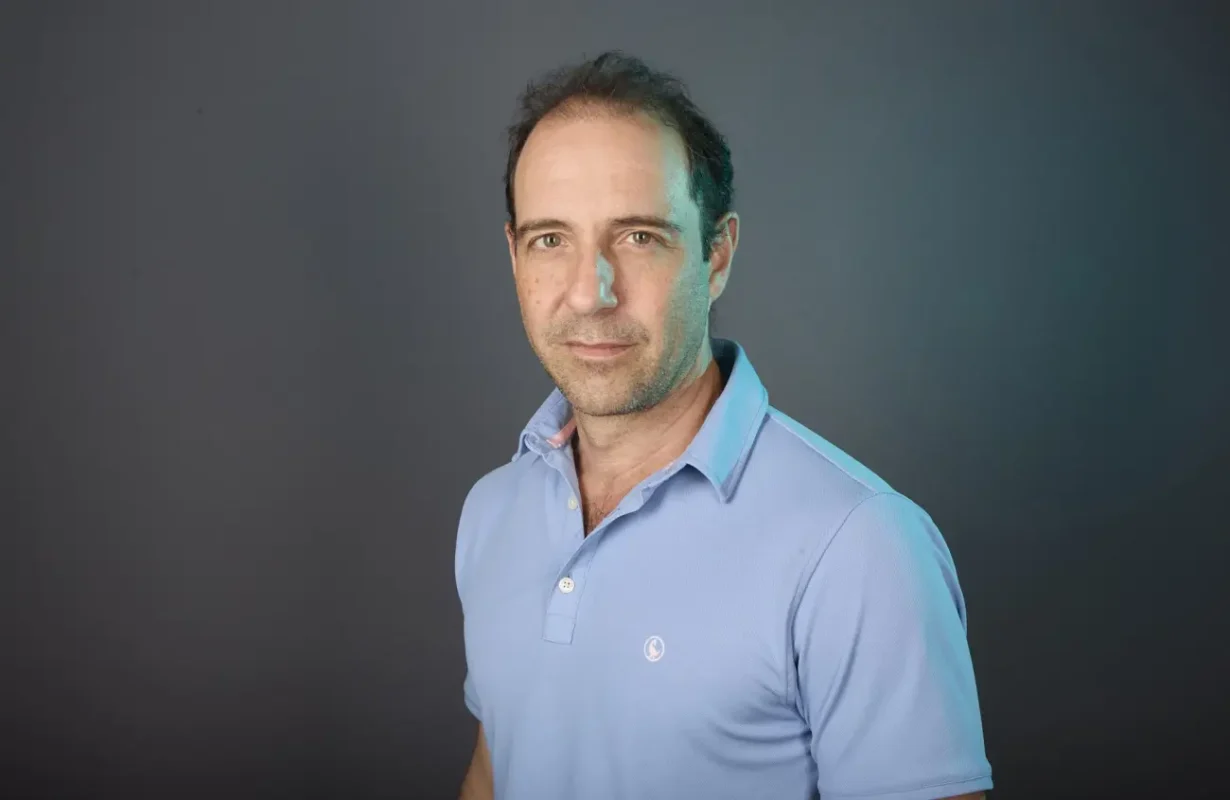
He began by taking apart watches, moved on to breaking into other people’s systems and eventually dismantled the price of a satellite: he brought the cost of a $400 million device down to $500,000. Fifteen years later, the company he founded to monitor crops and forests generates 90% of its business from defense and is one of the best-performing stocks on Wall Street this year.
The price of a satellite
The question behind Satellogic is almost offensively simple. At the end of the last decade, a high-resolution Earth observation satellite cost between $300 million and $400 million, and Emiliano Kargieman began looking at what it was actually made of.
“It has carbon fiber, a little electronics and a couple of mirrors,” he says. “How can it cost $400 million? If I give you a van and tell you, ‘Here, fill it with technology,’ how do you make it cost $400 million? It is impossible.”
His conclusion was that much of the price came not from physics, but from engineering methodologies and the types of contracts used to purchase space technology. Computing and space technology were both born out of the postwar period, he says, but only one of them went through a process of democratization. The satellites manufactured by his company cost $500,000 and perform the same function.
That instinct goes back a long way. Kargieman describes himself as “the same kid who took watches apart at the age of six and then tried to put them back together, but never managed to do it.”
A product of public education, he received a computer at the age of nine and learned to program in Assembly because he was terrible at video games: he lost too quickly. At twelve, he bought a modem and spent his nights breaking into other people’s systems, while attending school for a few hours in the afternoon.
At fifteen, he started his first software company and hired classmates from secondary school. At nineteen, he founded Core Security Technologies, which did professionally what he had previously done for fun: breaking into systems to reveal their vulnerabilities.
“Core was my MBA,” he says.
He left at the age of thirty, when the four or five friends who had started out in a café in Belgrano had become a company with more than 400 employees.
Then came what he calls the mistake. In 2007, he founded Aconcagua Ventures with Jonatan Altszul to finance other entrepreneurs. It lasted three or four years, and he describes the experience without euphemisms: frustrating, at a time dominated by advertising networks and consumer profiling, which he regarded as “very secondary problems.”
Out of that disappointment came his own list of problems worth solving, at the intersection of energy, food and water.
“One thing led to another, and I ended up building satellites as if it were nothing.”
He founded Satellogic in 2010 with Gerardo Richarte.
“Lack of awareness is an entrepreneur’s best ally,” he says now. “Not knowing how difficult the thing you are about to do really is can be one of your best tools.”
The detour the market rewarded
Today, the company has 21 satellites in orbit and the largest high-resolution constellation in the world. Its stated objective —remapping the entire surface of the planet every day— now has a timetable.
The Merlin constellation, consisting of eight satellites with onboard processing, will begin launching in October and is expected to become operational in early 2027.
To explain its purpose, Kargieman uses the image of a conversation: feeding a language model with an updated view of the planet and asking it where the oil tankers in the Strait of Hormuz are or how many trees were cut down in the Amazon yesterday.
“Asking the planet questions.”
None of it went according to plan. In 2020, the company needed capital, the private market was closed and Satellogic entered Nasdaq through the SPAC route, almost at the end of that wave.
“It was not as though becoming a public company had been a lifelong dream of mine,” he clarifies.
What followed were three difficult years. The market collapsed, and a change in United States government procurement rules delayed the business plan by between 18 and 24 months. The company went from 470 employees to 150 and then began growing again, all under public scrutiny.
The other detour was more fundamental. Satellogic was founded with an explicit decision not to work in defense. Kargieman dates the shift to between 2017 and 2018, when the world moved from a unipolar order to “a conflict of everyone against everyone.”
His argument is that hiding would have been worse.
“We cannot hide behind the idea that we only make technology and that other people can then do whatever they want with it.”
Today, nearly 90% of its clients come from the defense and intelligence sectors.
The irony is that this shift, which he had never sought, is precisely what the market rewarded. In 2026, Satellogic shares rose by more than 400%, pushing the company’s market value above $1.3 billion, driven by sovereign demand for geospatial intelligence. Revenue from that segment increased 80% year over year during the first quarter.
The Argentine company manufactures its satellites in Uruguay, while its founder lives in Barcelona.
When asked for a specific example, however, Kargieman does not choose a contract. He chooses the United States withdrawal from Afghanistan, when the world’s satellites were fully occupied and organizations evacuating refugees had been left without information.
Satellogic helped identify where helicopters could land and which areas remained outside Taliban control.
“There are 100 families living around the world today who are alive because we were able to provide them with that information at the right moment.”
The Patagonian bet
His other project is Sur Energy, the company behind Stargate Argentina: a data center in Patagonia involving an investment of up to $25 billion and 500 megawatts of capacity, with OpenAI purchasing the computing power —rather than investing in the project— under the RIGI incentive regime.
The idea grew out of years of conversations with Matías Travizano, his best friend, who died in a mountain accident in September. They had discussed what twenty-first-century infrastructure should look like if the infrastructure of the past consisted of railways, ports and bridges.
Kargieman is searching for a CEO for Sur because his main focus remains Satellogic. He acknowledges the real risk of the business: investing too much too early, as telecommunications companies did when they laid fiber everywhere and failed to see returns within the timeframe they had expected.
What the project requires instead is something harder to secure in Argentina than capital.
“I hope that, because this begins during Milei’s government, it is not treated as a libertarian project. Long-term projects require alignment from everyone.”