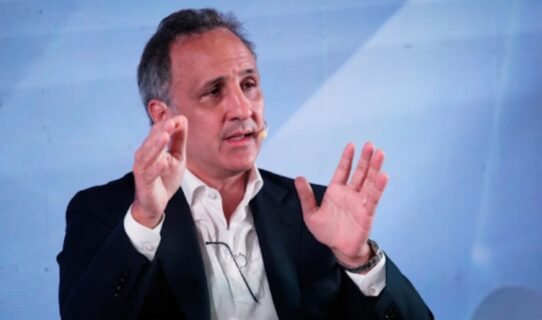




Reelected at the head of the CIQyP until 2028, he has established himself as one of the leading executives in Argentina’s petrochemical industry after a global career at Dow.
Matías Campodónico is a lawyer who graduated from the University of Buenos Aires and is now one of the most visible faces of the country’s chemical and petrochemical industry. He chairs PBB Polisur S.R.L., one of Argentina’s main petrochemical companies, and since June 2026 has headed the Chamber of the Chemical and Petrochemical Industry (CIQyP) for the second consecutive time, after being reelected by the members’ assembly for the 2026–2028 period. His name comes up whenever the discussion turns to how to turn Vaca Muerta gas into industrial production.
His path did not follow the classic route of a manager who grows inside a single plant. Before reaching the leadership of the sector, Campodónico spent more than a decade at Dow, with postings in Buenos Aires, the United States and Brazil, and added an academic background that is unusual for an industrial executive. That intersection of law, communication and international relations became his distinctive mark when representing large chemical companies before the State and investors.
From law to Dow’s front line
The foundation of his profile lies in the classroom. He graduated as a lawyer from the UBA in 2001 and, rather than narrowing his path, pushed his education into other fields: a master’s degree in Journalism at Universidad Torcuato Di Tella in 2003, and another in International Relations at King’s College, University of London, in 2005. Two major international scholarships supported that path: the Fulbright Scholarship from the U.S. Department of State in 2003 and the Chevening Scholarship from the British Foreign Office the following year.
With that background, he joined Dow in Buenos Aires in 2011. Two years later, he moved to the company’s headquarters in the United States, where for four years he was part of the global CEO’s team. From there, he coordinated programs with the World Economic Forum and the International Olympic Committee, settings where business intersects with global politics. In 2017, he moved to São Paulo as regional director of government and public affairs for Latin America, and in May 2022 he became president of Dow for Argentina and the South Region. From coordinating global agendas, he went on to manage the regional operation of a chemical multinational.
PBB Polisur and the helm of petrochemicals
That trajectory explains why his name carried weight when the sector sought leadership. Campodónico now heads PBB Polisur, and from that position serves as president of the CIQyP, which he had already led during the 2024–2026 period. The fact that the same companies chose him again says a great deal about how they assessed his first term.
The 2026–2028 board surrounds him with leading names in Argentina’s chemical industry: Marcos Martín Sabelli, of Profertil, as first vice president; Carolina Porchile, of YPF, as second vice president; and Matías Guido Martin, of BASF Argentina, as third vice president, with Jorge de Zavaleta as executive director. Coordinating companies that compete with one another, and getting them to speak with a single institutional voice, is part of the work that defined his reelection.
When thanking the members for their trust, he laid out his reading of the moment: “We have productive capacities, excellent human resources and unique opportunities associated with energy development and new value chains.” The phrase carries greater weight when viewed against the numbers of the sector he leads: an industry that contributes around 12% of national industrial production, supports more than 69,000 direct jobs and some 250,000 indirect jobs, and supplies inputs to more than 96% of the country’s industrial activities.
The CEO betting on Vaca Muerta
The axis of his second term has precise coordinates. Vaca Muerta appears as the great opportunity for petrochemicals: Neuquén’s natural gas under competitive conditions makes it possible to produce fertilizers, plastics and industrial chemicals at better costs, replace imports and gain export markets with higher value-added products.
Based on that potential, Campodónico and his team laid out an agenda for the next two years focused on competitiveness, sustainability, technological innovation and coordination between companies and public agencies, with specific chapters on regulatory improvement, foreign trade and industrial process safety. The measure of his management by 2028 will be concrete: whether the sector manages to transform the potential of underground resources into real production, employment and exportable added value. In a sector that moves almost one fifth of the country’s industrial manufactures, there is little room for that objective to go unnoticed.