




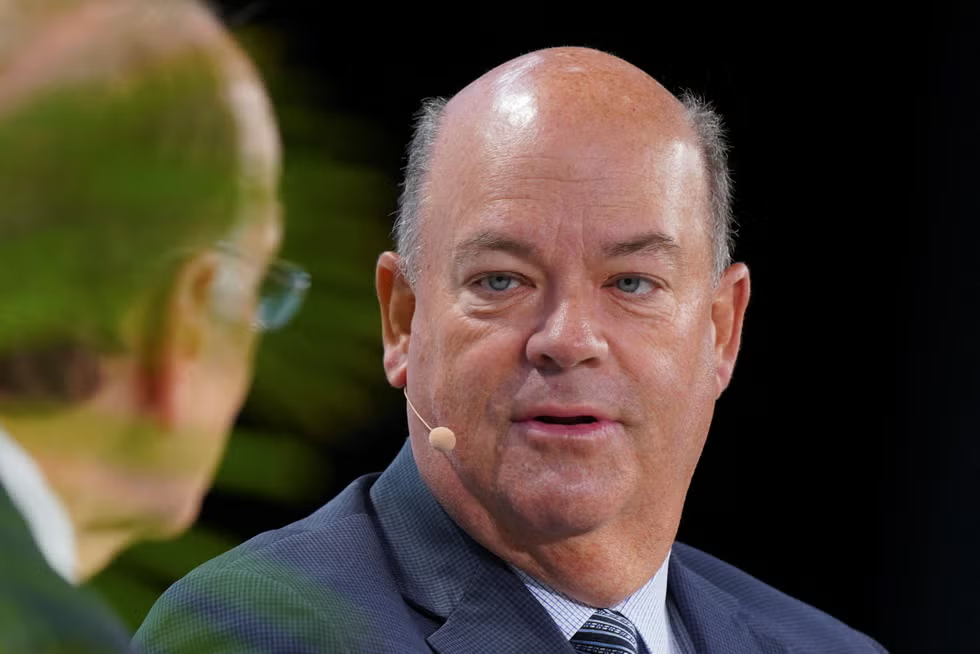
The engineer who paid his way through university by working on a Wyoming drilling rig and now runs the world’s largest independent oil company.
Ryan Lance did not enter the oil industry from an office.
He was born in Arkansas in 1962, although he grew up in Great Falls, Montana, where his family moved because of his father’s work in the Air Force. His parents, both graduates of Montana State University, assumed he would study engineering in Bozeman because of his ability with mathematics. But a visit to the campus in Butte changed his direction. Years later, he recalled that the school had a simple and powerful reputation: anyone who graduated found a job.
He enrolled in Petroleum Engineering at Montana Tech and paid for part of his studies by working every summer on drilling crews in Wyoming. He started at the bottom, learned the trade in the field and graduated in 1984.
A career that began in Alaska
That same year, he joined ARCO Alaska. In 1989, however, he was transferred to Bakersfield, California, to work in the company’s operations. He later moved to Phillips Petroleum and continued his career at ConocoPhillips after the merger.
His career was built step by step. Before reaching the top, he led downstream strategy, technology and major projects. He managed exploration and production operations in Europe, Asia, Africa and the Middle East before taking responsibility for all international operations. His rise to the highest position came after working across almost the entire company.
In May 2012, he became chairman and CEO.
The current scale
Today, he leads the world’s largest independent oil company by reserves and production, with operations in dozens of countries. In Alaska, where it ranks as the leading producer, its flagship project is expected to deliver first oil in 2029.
Under his leadership, ConocoPhillips has sought to replace high-cost assets with resources capable of producing profitably at lower prices. That policy explains the acquisitions of Concho Resources, Shell’s unconventional assets and the remaining interest in Surmont. The most ambitious transaction was the purchase of Marathon Oil, which added more than 2 billion barrels with a cost of supply below 30 dollars.
Without price, there is no investment
The question was very direct: when will US shale production reach its peak? Ryan preferred not to tie his answer to a number or a date.
“I want to know the price.”
With that sentence, the conversation moved in another direction. The idea became clear. For the CEO of ConocoPhillips, no projection about shale is possible without first considering the price of crude oil.
The conversation, however, had begun elsewhere. Later, the focus shifted to “drill, baby, drill,” the slogan that returned to the centre of the US energy debate. His argument was broader: producing more does not depend solely on adding drilling rigs in the field. It also requires progress on permits, power infrastructure, pipelines and LNG exports. In his view, growth can only be sustained if those conditions develop alongside production.
The next issue was costs. The question was whether the impact of tariffs had changed shale’s break-even point. Ryan acknowledged that there had been adjustments, although he did not consider them large enough to alter the company’s investment plans. He used the answer to explain how he sees the market. Production can continue growing with prices between 65 and 75 dollars per barrel, he said. When prices fall below that range, production begins to expand more slowly. Near 50 dollars, the outlook changes completely.
It was then that he issued another warning. In his view, US shale production could stabilise towards the end of this decade unless a new technological improvement emerges to drive productivity higher once again.
Even so, he offered a sentence that summarises his confidence in the industry.
“Do not assume that we are going to fail.”
His point concerned the ability of US shale to adapt whenever it reaches a new limit.
Liquefied natural gas entered the conversation near the end. Lance projected expanding demand and rejected the idea of sustained oversupply. In his view, global energy consumption still has room to grow, especially in regions with limited access to electricity.
The conversation ended where it had begun. According to Lance, the United States can still increase production beyond 14 million barrels per day. He clarified, however, that this projection only holds if oil prices remain supportive for several years. The price on a particular day does not matter, nor does the price over three months. What matters is the price that can endure.
His argument also helps put projections for other markets into perspective. It raises an unavoidable question: if the world’s most competitive shale industry expects moderate growth and a limit towards the end of the decade, how much room is available for developments that are only beginning?
Vaca Muerta is seeking to make the leap into exports, but the international outlook shows that even market leaders face limited growth. The key lies in reducing the cost of financing projects and finding tax incentives that allow them to compete under better conditions.
Ryan Lance’s argument suggests that none of those tools can remove the underlying constraint. The main constraint is the international price, determined by the market.