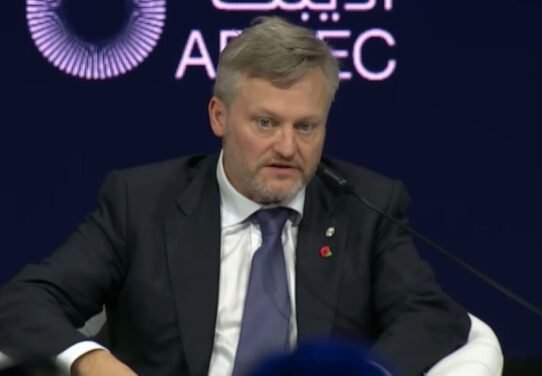





Daniel González, coordinating secretary for Energy and Mining, focused on the reduction of export duties on conventional crude oil, reviewed the projects seeking admission to the RIGI and outlined the tenders intended to expand Argentina’s energy infrastructure over the coming years.
Before coordinating the Energy and Mining secretariats, Daniel González spent his career on the other side of the table.
His entry into the energy industry came through finance. A Business Administration graduate from the Argentine Catholic University, he began working at Transportadora de Gas del Sur in the early 1990s. He later joined Merrill Lynch and remained there for fifteen years, until the bank became part of Bank of America.
He arrived at YPF as chief financial officer shortly after the 2012 expropriation. From that position, he worked to rebuild the company’s relationship with the markets and restore its access to international financing. In 2018, he was appointed CEO and led the company until April 2020.
After his time at IDEA, he returned to public administration. Since July 2024, he has reported to Luis Caputo, coordinated the two secretariats and led the committee responsible for analysing RIGI projects.
At heart, he continues to perform the same task: translating Argentina’s potential into a credible valuation.
Argentina’s energy agenda has moved beyond managing scarcity and begun focusing on how investment should be directed. González organised the sector’s agenda around four priorities: the tax burden on conventional crude oil, the arrival of new companies in Vaca Muerta, the regulatory obstacles holding back copper development and the upcoming infrastructure tenders.
High costs affect one third of production
The agreement suspends export duties on conventional oil under the current price scenario. The proposal seeks to provide relief to a strategic activity with narrower margins than unconventional production.
“These are quite old developments with a very high water cut,” González explained.
These fields have been operating for more than a century. As production declines, the cost per barrel rises, even when operating expenses remain stable. The fall in crude oil prices placed additional pressure on company finances and reduced provincial royalty revenues.
The framework allows operators and provincial governments to determine how the improvement in profitability will be distributed, with the objective of sustaining investment and employment. The measure covers Chubut, Santa Cruz, Río Negro, Neuquén, Tierra del Fuego, Mendoza and part of La Pampa.
One fact is particularly relevant from a corporate perspective: the main beneficiaries are not the major oil companies. González emphasised that the measure primarily supports smaller operators.
Unconventional production attracts most of the investment made by large companies because of its stronger returns. Conventional oil has largely remained in the hands of medium-sized companies which, despite generating significant revenue, operate on a smaller scale within the industry and are major employers in several provinces.
Vaca Muerta: record production and new entrants
Oil production reached its highest level on record in October 2025. According to González, the return of investment has been accompanied by greater productivity in Argentina’s unconventional wells compared with similar developments in the United States.
The formation produces slightly more than 500,000 barrels per day and, according to González, remains far from reaching its full potential.
The arrival of Continental, a company that helped pioneer shale development in the United States, reinforced the view that international perceptions of Argentina are changing.
The Government considers offshore activity to be at an early stage. Although the only deep-water well drilled so far proved unproductive, YPF and other operators are continuing with exploration. González argued that the debate should not be framed as offshore development versus no offshore development, but around the rules and controls that should govern the activity. Norway, he noted, demonstrates that offshore operations can be carried out under strict environmental requirements.
A reform still pending
The mining sector faces a clear regulatory constraint. For González, reforming the Glaciers Law is a necessary step towards unlocking copper development.
The proposal seeks to move beyond a general prohibition and give greater decision-making authority to the provinces, which constitutionally own the natural resources.
“Copper in Argentina is another Vaca Muerta,” he said.
International interest has already resulted in acquisitions by major mining companies. While Glencore has moved forward with two large-scale copper projects, BHP and the Lundin Group are still awaiting a reform that would allow Vicuña to enter the incentive regime.
San Juan is emerging as one of the main destinations for large investments during the next decade.
RIGI: 28 projects submitted, nine approved
Of the 28 initiatives submitted to the regime, nine have already been authorised. The distribution is almost even between mining and energy projects, with one steelmaking initiative and another related to logistics.
The approval process involves the substantive unit of the relevant government department, consultations with the Central Bank, the Treasury Attorney General’s Office and competition authorities, and concludes with an evaluation committee composed of eight officials.
González acknowledged that the timeframes could be shortened, although he justified the delays by pointing to the depth of the review process.