


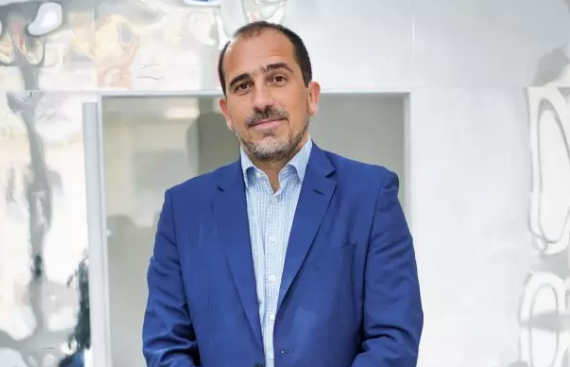
The electronic engineer who now leads 4 GW of generation capacity began his career selling contracts at a power plant in Salta.
Martín did not train to build power plants.
He graduated from the National Technological University and completed a postgraduate degree in electricity and natural gas markets at ITBA, an Executive MBA cum laude at IAE Business School of Universidad Austral, and a management certification at the Darden School of Business at the University of Virginia. His original degree, however, is in electronic engineering, a field connected with sensors, control, measurement and systems capable of making real-time adjustments.
Thirty years later, much of what he learned remains present in the problems currently facing the sector.
The executive responsible for selling energy
Before joining AES, he worked at Mercados Energéticos Consultores, where he was responsible for Latin America and the Caribbean. He also worked at EDF Global Solutions, part of the French Électricité de France group, as international sales manager.
Martín joined AES in 2006 through Termoandes, the thermal power plant in Salta, where he became commercial manager. His career at AES began in the commercial area, negotiating contracts and working on the energy business rather than operating the plant.
He later became general manager of Termoandes, managing director of operations at AES Argentina and, in 2015, president and CEO.
During almost twenty years within the group, he worked in different areas of the business before eventually taking charge of the company. It was a rise sustained over time rather than a sudden leap.
Today, the company he leads has more than 4 GW of installed capacity across ten plants in Buenos Aires, Neuquén, Salta and San Juan, combining thermal, hydroelectric and wind generation. It is one of the longest-established multinational energy companies in Argentina, with almost 33 years in the country.
Before discussing new generation, Martín looks at grid capacity.
He approaches Argentina’s electricity problem from an unusual perspective. Renewable generation continued to expand, but transmission lines did not grow at the same pace. That difference left the grid with very little available capacity.
Genesio says the system “collapsed in a positive sense” because new generation was added without expanding transmission lines at the same rate. Today, there is very little room to incorporate additional generation, whether wind, solar or thermal.
The data show that the problem already has concrete consequences. In March 2026, grid constraints prevented 91,580 MWh of wind and solar generation from being used, the highest figure since 2020. Cuyo accounted for almost two-thirds of the energy that could not be delivered. In just one month, enough electricity was wasted to supply around 38,000 homes for an entire year.
Martín recalls that, in the early years, renewable sources appeared capable of accounting for the entire expansion of the electricity system. The difficulty is that wind and solar generation depend on weather conditions rather than on the moment when the system needs power.
He argues that the transition forced the sector to understand a central distinction: generating energy is one thing, while being able to deliver it when needed is another. This diagnosis points to two paths that must advance together.
The first is natural gas. Genesio assigns a central role to efficient thermal plants, particularly lower-emission combined-cycle facilities, as backup for an increasingly diversified electricity mix. His position goes further. The transition requires combining different technologies according to what the system needs at each moment.
The second component is storage, which gained ground, he explains, as battery costs declined. The local response came quickly. AlmaGBA awarded 713 MW at sensitive points in the Edenor and Edesur networks, with investments exceeding US$540 million. The scale of interest became even clearer when the scheme was extended to the rest of the country: 235 projects were submitted for a total of 8,335 MW, more than ten times the capacity tendered.
AES Corporation and Siemens joined forces in 2017 to create Fluence, a company specialising in battery storage systems. Today, it is listed on Nasdaq and ranks among the world’s leading companies in storage-system integration.
Before Fluence, there was AES Energy Storage, a division that had already spent ten years working with storage when batteries still occupied a marginal place in the sector. Martín does not speak about batteries as an outside observer. AES became involved in that market during its early stages.
Not every storage project is designed to solve the same problem. In the Buenos Aires metropolitan area, AlmaGBA places batteries at points where the grid needs additional support during peak-demand hours. Part of the energy produced in Cuyo and Patagonia is lost because the network lacks sufficient capacity to transport it to the main consumption centres.
Multinational companies as a balancing factor
According to Martín, it is not enough to know how much is invested. It is also necessary to examine where that money ultimately goes.
The sector needs local companies, both small and large, alongside multinational corporations with global capabilities. Initial financing solves only the first step. It is also necessary to know under what conditions the investment will remain in place throughout the many years required by a project of this scale.
For him, the departure of multinational companies in recent years reveals a problem in the composition of investment. The challenge now is to define rules capable of restoring that balance.
AES’s next wind investment will be at Vientos Bonaerenses, the complex located between Bahía Blanca and Tornquist, where the company already operates two wind farms.
The project involves approximately US$150 million, sixteen Vestas V162 wind turbines with a capacity of 6.4 MW each, and an additional 102.4 MW that will double the complex’s capacity. Construction is expected to create around 400 direct jobs. Genesio estimates that operations will begin in early 2027.
In Neuquén, AES is also responsible for the province’s only wind farm.
His position is direct: before adding new generation capacity, Argentina needs a grid prepared to transport it.