



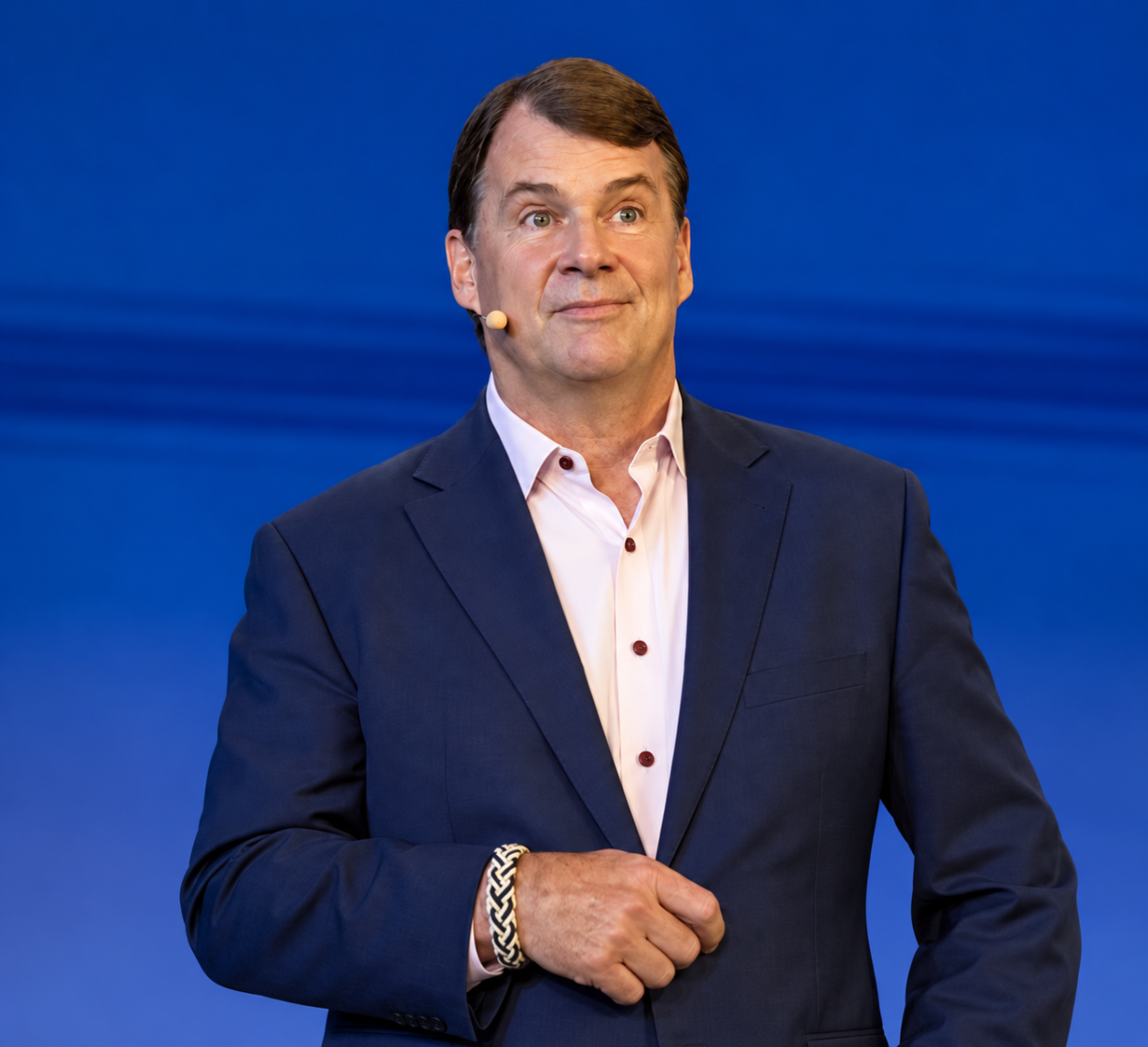
It is unusual for the CEO of an automaker with more than a century of history to publicly admit that his company is losing ground. Jim Farley does it fairly often.
In recent months, he acknowledged that the Mustang Mach-E, one of the electric vehicles he promoted most strongly inside Ford, does not represent the company’s future. He also said that spending years competing with models such as the Fiesta and Focus against Toyota and Korean brands may not have been the best decision. And he was even more direct when discussing China: his team, he admitted, was not prepared to compete with BYD.
Farley seems comfortable saying things that are not always easy to hear inside a company like Ford. Part of his job, as he sees it, is precisely to force the company to recognize where it has fallen behind.
A Team Separate From Ford
Four years ago, he asked a fairly simple question: could Ford build an affordable electric vehicle and make money on it at the same time?
The answer he received was no.
Doug Field, who had been chief engineer of the Tesla Model 3 and had also worked on Apple’s automotive project, told him that much of Ford’s design and software systems were decades behind.
Farley then decided to create a new team in California, separate from the company’s traditional structure. The group was even free to decide which Ford employees could join and which could not. He essentially told the rest of the company to leave them alone and let them work.
The decision generated resistance. Ford had spent more than a century building cars and refining combustion engines, and there were still people inside the company who believed the strength of the Ford brand would be enough to compete with Tesla.
That team developed the Universal EV Platform, a new electric architecture designed to use fewer parts and simplify manufacturing as much as possible, including through large cast-aluminum components.
Its first vehicle will be a pickup with a shape unlike traditional trucks, more spacious than a Toyota RAV4 and scheduled for 2027.
The platform’s name also revives an old Henry Ford idea: building a vehicle that could reach an enormous number of people.
Farley, however, avoids presenting the project as a certainty. He says nobody has previously tried to build a vehicle with those characteristics at that price and that Ford still has to prove it can do it.
China Is the Rival
When Farley talks about the future of electric cars, he is not primarily looking at Detroit.
For him, the toughest competition is in China.
He has described the country as the industry’s “700-pound gorilla” and argues that Ford, General Motors, and Tesla are currently not at the level of some vehicles produced by Chinese brands.
The size of the market helps explain his concern. Around 20 million vehicles are sold in China each year, and nearly half are already electric or extended-range hybrids. In the United States, electric vehicle sales are only around one million.
China also manufactures close to 60% of the world’s electric vehicles. And its expansion is no longer limited to its domestic market: one in four cars sold in Mexico comes from Chinese manufacturers.
Farley looks at the problem primarily through the lens of cost.
He says any company can announce a $30,000 electric vehicle. The real question is how much it costs to build. If production costs $50,000, there is not much of a business behind it.
That price point, around $30,000, is particularly important for Ford because roughly two-thirds of the vehicles sold in the United States are used and trade at similar prices.
Farley often recalls that Ford reacted late to the rise of Japanese automakers and then to Korean manufacturers. He does not want the same thing to happen with China.
There is a certain irony in the history. Hyundai began in the 1960s by assembling Ford models, including the Cortina. Ford even once held a stake in Kia before Hyundai ultimately acquired it in 1998.
The Cost of Tariffs
Farley’s other problem is in Washington.
Ford manufactures in the United States more than 80% of the vehicles it sells there, a higher proportion than many of its competitors.
But manufacturing locally also means importing a large number of parts. That is where tariff costs begin.
In a quarter when Ford reached record revenue, the company ended up recording an operating loss of around $800 million related to tariffs. According to Farley, the annual bill for imported parts is around $2 billion and at one point absorbed nearly 20% of profits.
His complaint is fairly straightforward.
A fully imported vehicle may face a 15% tariff, or 12.5% if it comes from Japan, while a pickup manufactured inside the United States may pay more than 50% on some of the steel and aluminum it uses.
Farley said he raised the issue with the U.S. administration and also spoke directly with the president.
He is more optimistic on that issue than he is about consumer subsidies.
He says Ford never built its strategy around expecting a $7,500 check for every electric vehicle sold. What he does consider important is support for producing batteries inside the United States.
How Far to Let Apple In
On technology, Farley has taken a different position from Tesla and Rivian.
Ford continues to offer Apple CarPlay and Android Auto because, he explains, the company should not force drivers to abandon the digital ecosystem they already use.
Farley said he has spoken with Tim Cook several times and tested Apple’s new automotive proposals. The first version of CarPlay Ultra, however, did not fully convince him.
There is a point where he draws a line.
It is one thing for Apple to control music, messages, or navigation. It is something very different for it to be able to start the car, limit its speed, or decide who is authorized to drive it.
If integration went that far, he says, Ford would probably have to choose between Apple and Google.
His argument is mainly about safety. In a vehicle that may one day drive itself on highways, he argues, the systems that truly matter need to be deeply integrated with the car.
That is why Ford is also developing its own artificial intelligence assistant, designed more as a permanent companion than a simple command system. Farley often cites what Nio already does in China as a reference.
On autonomy, he also prefers to focus first on something he considers more useful to customers: hands-free highway driving and, eventually, driving without the need to keep watching the road continuously. Robotaxis are not his priority.
A Shortage of Technicians
There is another problem Farley talks about frequently that has little to do with electric vehicles.
There is a shortage of skilled technical workers.
Mechanics, electricians, plumbers, factory workers, and emergency personnel are all part of what he calls the “essential economy.”
Ford’s dealership network alone has around 8,000 unfilled technician positions, some paying close to $120,000 a year.
The company invested around $1 billion in improving safety and working conditions at its plants. It also launched initiatives with Carhartt to provide tools to people beginning technical careers.
Farley believes that is not enough.
In his view, the problem is too large for a single company to solve on its own and requires coordination among businesses, governments, and education systems.
A Different Ford
The change in direction also comes with costs.
After announcing its new electric strategy, Ford recorded a $19.5 billion accounting loss related to that business, discontinued the F-150 Lightning, and also lost Doug Field.
In Europe, the company is placing more emphasis on higher-margin vehicles such as the Mustang, Bronco, and pickups.
That has generated criticism from people who still associate Ford with affordable, high-volume cars.
The departure of the Kuga will leave a significant gap in the lineup, while the alliance with Renault has fueled another debate: to what extent will future mass-market Ford vehicles remain genuinely Ford products rather than models developed by another manufacturer with the blue oval placed on them?
Farley knows the strategy carries risks.
But his priority appears fairly clear: selling fewer cars may be acceptable if Ford can make the ones it does sell into sustainable businesses.
After years of competing for volume, he is trying to bring the company back to something more basic: building vehicles that people want to buy and that also make money.