


There is one phrase that cannot be said at Spotify during the most important meeting of the week: “let’s take this offline.”
The meeting is called E-Team. It takes place on Tuesdays, lasts around three hours and brings together fourteen people. The people responsible for marketing, advertising, subscriptions, product, technology, content and the rest of the company’s major areas are all there.
The ban came after years of seeing the same scene repeated over and over. Someone would raise a problem, explain that it depended on another person who was not in the room and suggest dealing with it later. Many times, that “later” never came.
The solution was not particularly sophisticated: put everyone in the same room.
If a launch is stuck because a licensing agreement still needs to be closed, the person responsible for licensing is there. They discuss it right then.
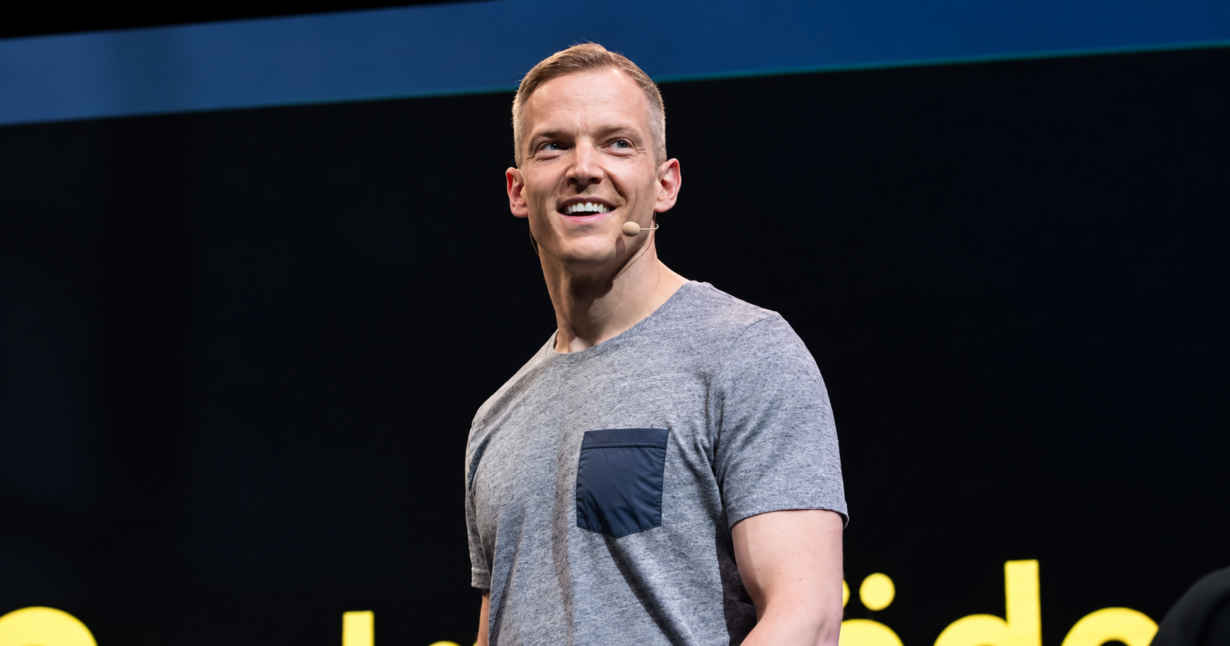
Gustav Söderström knows it is expensive. Fourteen executives spend three hours together every week, and much of what is discussed is not immediately relevant to each of them. He defends it anyway.
He says the benefit appears later. Someone might spend forty minutes listening to a discussion about advertising that has nothing to do with their work today, but a year from now they may have to make a product decision while understanding where the money comes from.
For Söderström, that time is not wasted.
It is a way of making sure fourteen people know considerably more than just their own area.
Since the beginning of 2026, he has shared the role of Spotify CEO with Alex Norström. The platform has more than 760 million users across 180 countries. Söderström is 50 years old, studied Electrical Engineering at KTH in Stockholm, practices jiu-jitsu and has spent eighteen years at the company.
Eighteen years at the same company
Before Spotify, he had already founded and sold companies.
One of them, which developed software for mobile communities, ended up being acquired by Yahoo in 2006. Later, he co-founded another company related to augmented reality that was acquired by Facebook’s Oculus division.
What he remembers about Yahoo is considerably less glamorous.
For a while, he thought he had not learned very much there. Later, he changed his mind. He had learned quite a lot about what he did not want to repeat.
There were four CEOs in two and a half years, executives fighting among themselves and departments holding back information as if sharing it meant giving up power.
He left convinced that he never wanted to work for a large company again.
Then he joined Spotify.
There were around thirty people.
Soon afterward, the company was preparing to launch in the United States and needed a deep integration with Facebook. Daniel Ek sent Söderström, who had only recently joined, to meet Mark Zuckerberg and close the deal.
What struck him was the trust.
He had been at the company for very little time and they were already sending him to negotiate something important.
When he tries to explain why he ended up staying for eighteen years, he goes back to that scene. He says that at Spotify he was able to change jobs many times without having to change companies.
Ek’s succession followed a similar logic.
Three years before the handover, Söderström and Norström were named co-presidents. First, they began managing the daily operation. Then the weekly operation. Then the monthly one.
By the time they finally became co-CEOs, they had already spent considerable time running the entire business, including the income statement and balance sheet.
What was new was something else: dealing with governments, facing the press and occupying the public role that Ek had held for years.
The six months Spotify thought it had
In 2015, Apple launched Apple Music, acquired Beats and brought in Jimmy Iovine and Dr. Dre.
Inside Spotify, Söderström says, they made a fairly brutal calculation: they had six months before Apple wiped them out.
Spotify was still a relatively small Swedish company and saw itself, above all, as being good at building products. Suddenly it was facing Apple, probably the product company they admired most.
They had a rough time.
But they survived.
Söderström believes part of the explanation was that, from the beginning, Spotify had chosen to do certain things Apple was unlikely to do in the same way.
The first was the free, ad-supported model. Spotify bet that Apple would never be particularly interested in doing that business well.
The second was personalization. At the time, Apple showed considerably more reluctance toward intensive use of data, while Spotify was convinced that better recommendations would become increasingly important.
The third was being everywhere.
Spotify wanted to work well on an Android phone, a Samsung television, in a car or on any other device. They believed Apple would always have some incentive to favor its own ecosystem.
Ten years later, Söderström believes all three bets worked.
He also acknowledges that there was a much simpler difference between the two companies: Spotify was fighting for its life.
For Apple, Apple Music was one more product. For Spotify, if it went wrong, there was no other company behind it.
A metric that tries to measure regret
For years, Spotify has worked internally with an idea it calls No Regrets.
The question is not only how much time a person spends on the platform. They also want to know how that person feels after spending that time there.
The idea came from a survey Spotify commissioned from an outside company. Users answered anonymously, without knowing who was behind the study, and compared different platforms: Spotify, YouTube, Apple Music, Amazon and TikTok, among others.
They were asked whether they valued the time they had spent there and how much of that time, looking back, they would have preferred to use differently.
Spotify performed well. Among Gen Z users, close to 90% said they valued the time they spent on the platform.
What surprised Söderström was everything else.
On some major platforms, young people said they regretted 60% or more of the time they had spent there.
He had assumed something fairly basic: if someone kept using an app, it was because they wanted to be there.
When asked, many said something different. They felt they could not get out.
That ended up affecting product decisions.
When podcasts began incorporating video, for example, several parents complained. They had allowed their children to use Spotify to listen to music, and suddenly they had another screen.
The company added an option to turn video off completely, even for free users.
That reduces usage.
Söderström knows it.
But he also says Spotify’s business allows the company to make a decision like that because almost 90% of its revenue comes from subscriptions.
A user who pays every month does not necessarily pay because they spent more hours inside the app. They pay because they felt the service was worth it.
That is why Spotify pays close attention to how many times someone comes back during the month, not just how many minutes they accumulate.
Söderström makes fun of the obsession with engagement a little: if the only goal were to make someone spend more time, being stuck in a traffic jam would be an amazing product.
A model that tries to learn taste
Söderström read Attention Is All You Need, the 2017 paper that became fundamental to today’s language models, a few days after it was published.
Then he started talking about it with anyone willing to listen.
Spotify began investing when it was still far from clear what all of this would eventually be useful for.
One of its acquisitions was Sonantic, a company specializing in voice generation. At the time, it was already possible to imagine that producing inexpensive artificial voices at scale would be useful, even though the models were not yet good enough to write the content those voices would read.
Söderström describes that way of investing as trying to intercept a curve before it arrives.
Now one of Spotify’s bets is what he calls a taste model.
A language model receives enormous amounts of text and learns which word is likely to come next. Spotify is trying to do something similar, but with listening sequences.
Songs instead of words.
Using trillions of those sequences, the system tries to learn what a person might want to listen to next.
The difference from earlier recommendation systems is that users can now talk to the model.
One of the features that emerged from this work shows users what Spotify believes their tastes are and allows them to correct it.
Someone can tell it, for example, that they have been listening to electronic music lately but actually want to return to classical music.
And the system can take that instruction into account.
For Söderström, that capability matters because artificial intelligence can lead in two directions.
It can be used to build an algorithm that becomes increasingly difficult to leave.
Or it can be used to give people a little more control over what the algorithm does with them.
He tries to apply the same idea outside Spotify.
He built an agent that prepares a daily audio report for him on topics he is interested in. He asked it to remove rage bait, clickbait and politics.
He knows his own weakness fairly well: videos of road-rage fights.
He can spend hours watching them.
So he simply asked the system not to show them to him.
He calls that idea premeditated media: deciding what you want to consume before the platform puts it in front of you.
What worries him most is not another platform
When Söderström thinks about the next few years, he does not talk much about Apple, YouTube or TikTok.
What concerns him most is knowing where they are in the technological cycle.
He says there are long periods when the world changes relatively little and it is enough to project forward what is already happening.
In 2015, for example, someone could have imagined the following decade fairly well simply by assuming more smartphones, more subscriptions and more digital consumption.
If they had done the same exercise in 2005, they would have missed the smartphone.
And with the smartphone, practically everything that came afterward.
Söderström believes they are now closer to 2005 than to 2015.
That makes planning much more difficult.
But he also likes it for another reason.
During stable periods, market positions tend not to move very much. Spotify, he says, gained more ground when the rules were changing.
That is why, faced with a period in which nobody really knows what the market will eventually look like, his answer is fairly simple:
try to get there first.