


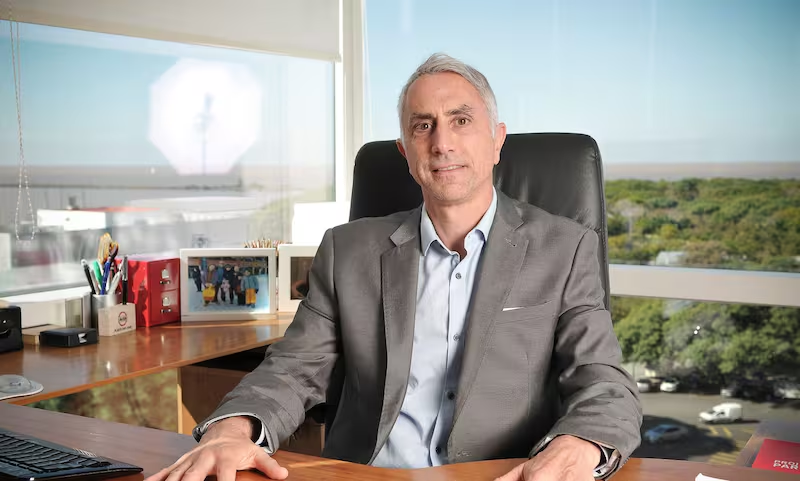
Sergio Damián Faifman joined Loma Negra at 20, when he was just starting university. He had accepted a six-month internship and did not expect to stay much longer. Yet he remained at the company and now, 32 years later, leads it. The cement producer is celebrating its centenary with new shareholders who decided to retain the management team.
Founded by Alfredo Fortabat in Olavarría, the company returned in 2026 to the control of a group led by Argentine capital after two decades under Brazilian ownership. Faifman remains CEO, a position he has held since November 2016. “These 100 years are not a celebration of the past, but a commitment to the future,” he says.
According to Faifman, more than half of Argentina’s buildings and infrastructure contain Loma Negra cement.
An open office and room for disagreement
Faifman rose through Loma Negra without thinking he would one day lead it. He says that for years he struggled to picture himself in that position: he thought the responsibility was too great for him. He likes his team to make decisions and test ideas without having to consult him about everything. He knows things can sometimes go wrong, but believes taking responsibility for those mistakes also helps people learn.
He says he almost never closes his office door and that anyone can approach him to talk, regardless of their position. He would rather people express their disagreements than agree with everything he says. He explains that he did the same with his own bosses: if he disagreed, he said so.
Studying and working at the same time
While working, Faifman studied for his public accounting degree at the University of Buenos Aires. He later continued his education, completing an MBA at the University of CEMA in 2002.
Before joining Loma Negra, he worked at a small accounting firm three blocks from home. He enjoyed tax work and was only in his first year at university when the opportunity for an internship at the cement company arose.
He was still living with his parents, and it was his first experience at a large company. His internship was repeatedly renewed until he became a permanent employee in November 1994.
From that period, he remembers a night when he worked until two in the morning. By nine, he was back at the office. When his boss saw him arrive, he pointed out that he needed to shave.
The path to leadership
His first roles were in Administration. Between 2006 and 2010, he headed Controllership and Tax at Loma Negra. He then moved to Brazil, where he served as InterCement’s corporate controller until 2012.
His time in Brazil allowed him to learn how other companies in the group operated. It was then that he began to think he could go further within the organization.
In 2012, he returned to Argentina as Loma Negra’s chief financial officer. He spent three years in that position before moving to Logistics and Procurement. In November 2016, he was appointed CEO and managing director.
He also served as vice chairman of the board and chaired Ferrosur Roca, Cofesur, Recycomb and the Loma Negra Foundation. That same year, he became head of the Portland Cement Manufacturers Association and the Argentine Portland Cement Institute.
His responsibilities also came to include managing InterCement Brazil.
Investments and new shareholders
One of the major investments during his tenure was the expansion of L’Amalí in Olavarría. The second production line began operating in 2021 and, according to Faifman, placed the facility among the largest and most modern in South America.
Its proximity to Buenos Aires, where demand is concentrated, and the new equipment helped reduce costs and improve production.
Loma Negra also invested more than $60 million in its factories to move from 50-kilogram bags to 25-kilogram bags. The change was also implemented across the rest of Argentina’s cement industry.
The change in ownership took place in April 2026, following InterCement’s court-supervised restructuring. Loma Negra had come under Brazilian control in 2005, when the Fortabat family sold it to the Camargo Corrêa group.
The new principal shareholders are Latcem, the investment vehicle headed by Marcelo Mindlin, Redwood Capital Management and funds managed by Moneda–Patria Investments. The transaction included a $110 million capital contribution.
Faifman explains that the company’s operations continued unchanged. The difference, he argues, is having shareholders who can plan for the long term without the previous financial pressures.
What endures after a hundred years
Loma Negra was founded in Olavarría in 1926 and has since lived through the ups and downs of Argentina’s economy. In a century, it has changed owners only twice.
Faifman attributes that continuity to knowing how to adapt and maintaining relationships with employees, customers and suppliers, even in difficult times.
Some customers and suppliers have been associated with the company for 50 or 60 years. For the executive, looking after those relationships requires looking beyond the price of a transaction and seeking agreements that benefit both sides.
He also returns to the importance of workforce training. A factory may require hundreds of millions of dollars, but its operation depends on the knowledge of the people running it. Without trained and committed staff, he warns, quality can deteriorate rapidly.
The demand the cement producer expects
Loma Negra is currently operating at around half its capacity. For that reason, Faifman does not consider expansion necessary in the short term. Investments are focused on reducing energy consumption, incorporating technology and improving environmental performance.
Even at that level of activity, he sees opportunities for growth. He points to the shortage of housing and infrastructure, and cement consumption per capita that he considers low compared with other countries.
Regarding the suspension of national public works, he notes that provinces, municipalities and businesses are also developing projects. For the cement producer, what matters is that construction goes ahead.
He is also following projects and tenders linked to RIGI, Argentina’s large-investment incentive regime. He expects those investments, scheduled to develop over the next three to five years, to generate significant demand for cement.
In housing, he believes access to financing remains unresolved. He considers construction costs per square meter reasonable compared with Brazil or Uruguay, but says many families have no way to finance a purchase.
“People around the world do not buy a house outright in cash,” he summarizes. A broader mortgage market, he argues, would allow that housing need to translate into new construction.
Ferrosur and decisions that require a longer horizon
Among his immediate concerns is Ferrosur Roca. The railway concession has been extended year by year, and the company is awaiting a tender that would allow it to plan over a longer period.
Faifman says they want to continue operating it and will participate when that process opens. Some projects have a payback period of four or five years, he explains, and undertaking them requires knowing the terms under which operations can continue.
At the plants, the schedule follows production and maintenance needs. Both L’Amalí kilns are expected to restart in November, following the winter shutdown used for major repairs. The Barker kiln is ready to start when demand justifies it.
When he took over, Faifman says, Loma Negra was already a leading company. He had to decide what changes would keep it that way. As he approaches ten years in the role, he believes that remains his task.