

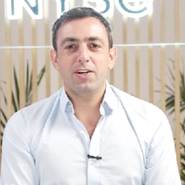


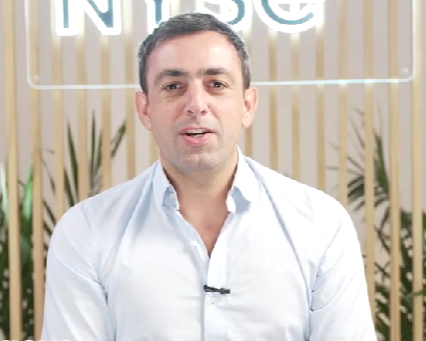
Gastón Irigoyen learned that Google was hiring in Argentina when someone handed him a sheet of paper after class. He was studying International Relations and, until then, had been looking for work at consulting firms and consumer goods companies. The paper, distributed at his university, listed an email address for applications. He applied and got the job.
By his account, he was Google’s fifth employee in Latin America, when the company was beginning to establish itself in the region. He later worked at YouTube, founded a company, joined a restaurant reservation platform and eventually entered the financial industry.
Today, he is co-founder and CEO of Pomelo, an Argentine company that develops technology enabling banks, digital wallets and other businesses to offer cards and process payments. He founded it in 2021 with Hernán Corral and Juan Fantoni, after the three encountered a similar problem from different positions: launching a financial product in Latin America could take a long time and required repeating the work in each country.
Pomelo has raised $160 million across four investment rounds. The most recent was a $55 million Series C co-led by Kaszek and Insight Partners. The company has around 300 employees, operates in eight countries and works with more than 150 corporate clients, including BBVA, Santander, Bancolombia, Rappi and Western Union.
A job search that ended at Google
When Irigoyen completed his International Relations degree at the University of San Andrés, a career in technology was not part of his plans. He was looking for opportunities at consulting firms and consumer goods companies. He reached the final interview stages but did not get the job.
Then Google’s recruitment opportunity appeared. The company had gone public about a year and a half earlier and was beginning to build its Latin American operation. Irigoyen applied following the leaflet’s instructions and was selected.
He joined Google in late 2006. That same month, the company acquired YouTube. In Buenos Aires, the office was just beginning to serve regional clients who had previously received support from Spain and Ireland. Over the years, the team also began taking on commercial responsibilities.
He later moved to Dublin to work at YouTube. His job took him across Europe in search of people uploading videos to the platform. Many were still building their audiences and beginning to discover that they could make money from their work.
Irigoyen helped them professionalize what they did and gain access to a share of advertising revenue. YouTube also had recording spaces in cities such as London, Hollywood and Tokyo that creators could use.
The decision to become an entrepreneur
At 27, Irigoyen left Google, where he had worked for six years, to found Guidecentral. The platform, focused on mobile content, began in Ireland. It took him to New York, and four years later, he sold the company in California.
When he returned to Argentina, he joined the management team at Restorando, a restaurant reservation platform. In 2019, TripAdvisor acquired the company.
That year, he began working on another project, this time backed by Grupo Galicia: creating a digital bank from scratch. The new company would operate separately from both the bank and Naranja’s traditional business in Córdoba.
The project began with an initial investment of $50 million and a financial company license from the Central Bank. Over time, it became Naranja X and also expanded into Mexico.
For Irigoyen, it was his entry into financial technology. There, he encountered the difficulties of building a payment system and launching products in different markets. That experience stayed with him when he began thinking about his next company.
The problem they found in payments
Before founding Pomelo, Irigoyen and Corral worked together on creating Naranja X. Corral had also spent twelve years at Mercado Pago. Fantoni came from Mastercard, where he had encountered similar problems.
All three agreed that launching a card could take between a year and eighteen months. Behind it were complex development projects, older systems and requirements that varied from country to country. When a company wanted to expand, it often had to start again.
Before founding Pomelo, they spent three months speaking with people in the financial sector: bankers, executives and consultants. They wanted to understand whether others faced the same difficulties they had encountered. After those conversations, they established the company and began looking for investors.
The company began operating in 2021. The idea was to enable a bank, digital wallet or fintech company to offer payment services without developing all the necessary technology itself. To do that, they created Pomelo’s platform.
When choosing the name, they wanted something short that could be pronounced in Spanish, Portuguese and English, and that sounded different from the usual names in the financial sector.
What Pomelo does
When someone pays with a card, the money does not move directly from their account to the merchant. First, systems identify the account, verify the transaction and communicate with the companies involved. Pomelo works on that part of the process, which takes place behind every payment.
Companies working with Pomelo use its platform to launch cards and offer them in different countries. Irigoyen says that, on one occasion, they managed to bring a card to market in five days. On another, a client began operating in a second country after two weeks.
The company processes different types of cards: some are linked to cryptoassets, remittances or corporate expenses. Others are used by delivery workers to pay for the purchases they deliver, or by truck drivers to buy fuel during their journeys.
Pomelo also announced a global product through which it aims to compete in 150 countries. According to Irigoyen, the company’s revenue grew by more than 250% over the past two years.
In 2024, he was recognized as a global innovator by the World Economic Forum and participated in Davos. That year, he also received Endeavor’s Entrepreneur of the Year award. He prefers to see those recognitions as part of a longer journey that includes good decisions, mistakes and many hours of work.
The cost of processing a payment
When explaining how the business works, Irigoyen uses an example: for every 100 pesos a consumer pays, the merchant receives around 97. The remaining three pesos are broadly distributed among different participants, such as the card network, the issuer and the companies processing the transaction.
That distribution depends on the conditions of each transaction. Irigoyen notes that international payments can have considerably higher costs than domestic ones. Companies such as Apple and Google also become involved when payments are made through their devices.
In his view, the business will continue changing as cards are used in new environments. First, they moved from plastic to phones and watches. Now, he is watching the development of artificial intelligence agents that could make purchases and payments on someone’s behalf, following the conditions that person sets.
For Irigoyen, it is becoming increasingly difficult to draw a line between a bank and a fintech company. Banks are adopting more technology, while digital companies are offering more financial services. What differs, he says, is the role technology plays within each company.
Pomelo already uses artificial intelligence for various tasks. Irigoyen says team members work alongside AI agents to complete them.
The talent he looks for
Irigoyen believes companies will need engineers, mathematicians and scientists, but also people who know how to listen, work in teams and lead others. As tasks change, he says, both technical knowledge and interpersonal skills will be necessary.
He also believes artificial intelligence could change the importance of experience when obtaining or keeping a job. At the same time, he sees opportunities for people just starting out.
Among the qualities he mentions most often is the ability to put an idea into practice: learning what is needed, using available resources and adapting when conditions change.
He advises aspiring entrepreneurs to find a specific problem and learn as they try to solve it. Mistakes, he says, will happen along the way. What matters is noticing them in time and correcting them.
With Pomelo, he has a project for many years to come. He wants the company to grow, create jobs and develop financial services in Latin America. He knows that takes time and follows a different path from building a company to sell as soon as an opportunity arises.