



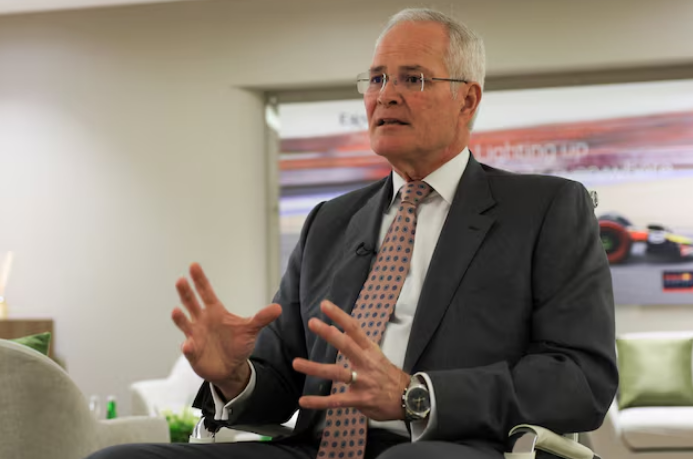
Darren Woods, born on December 16, 1965, is one of the most influential executives in the global energy industry. He has more than 30 years of experience in the sector and served as chairman and chief executive officer of ExxonMobil. From 1992 to the present, engineer Woods has held several positions within Exxon, including vice president and later senior vice president.
He is also part of several business affiliation spaces. Most senior executives are linked to national councils, business councils and institutes within the sector. Woods is an engineer and represents a generation of corporate leaders who experienced the transformation of the oil industry from the global expansion of the 1990s to the contemporary challenges linked to the energy transition, supply security and geopolitical volatility.
The engineer was born in Wichita, Kansas, and studied electrical engineering at Texas A&M University. He later earned an MBA from Northwestern University, and his entry into Exxon took place in 1992, when he began working in different areas linked to planning, refining and business development. In 2017, he became chairman and chief executive officer of the company.
Woods took control of one of the world’s largest energy companies at an uncertain moment, with several changes taking place within the sector. Pressure from financial markets, regulatory changes and the advance of discussions on climate change shaped the international environment and context. The American executive led the situation successfully and without hesitation.
Woods’s career inside Exxon
Before reaching the executive chairmanship, he passed through different business units related to refining, petrochemicals and international operations. One of the key moments in his career was his appointment at the head of ExxonMobil Refining & Supply Company, where he gained experience managing one of the most important refining networks in the world.
He later headed another part of the company: ExxonMobil Chemical Company, a division considered strategic because of its high profitability and its ability to diversify the company’s income beyond oil and gas production. His performance in that unit strengthened his profile within the organization and made him one of the main candidates to succeed Tillerson.
When he became CEO, Woods inherited a company with enormous financial and technological capacity. He also inherited a company seeking to redefine its global strategy amid worldwide imbalances, crude oil prices and the oil crisis. What did he do in that situation? The engineer opted for new investments in other strategic parts of the world.
ExxonMobil’s expansion under his leadership
For that reason, one of the distinctive features of Woods’s management was his commitment to growth. Unlike other oil companies that entered a stage of hydrocarbon reduction, ExxonMobil advanced with a strategy aimed at increasing production, reserves and operational capacity. This idea was implemented by Woods, who was often described as a visionary leader.
The most emblematic case was Guyana. Under his leadership, ExxonMobil led a series of offshore discoveries considered among the most important of the 21st century. The findings transformed the small South American country into one of the new emerging oil powers and consolidated Exxon as a dominant player in the region. Guyana was one of the points identified by the engineer in his drive for long-term growth.
He also promoted expansion in the Permian Basin in the United States, one of the world’s main shale oil-producing areas.
The executive facing the energy transition
Woods’s view of the energy future is characterized by strong pragmatism. A pragmatic leader stands out for efficiency and problem-solving capacity. He focuses on reality and on the practical handling of problems. For that reason, Exxon’s longtime leader has argued that oil and gas will continue to play a central role in the global economy for decades.
During his management, and especially under global pressure to reduce carbon emissions and preserve ecosystems, ExxonMobil increased investments in carbon capture and storage, industrial emissions reduction, hydrogen and fuels with a lower environmental footprint. This area was central under the leadership of Exxon’s chairman, who maintains that environmental actions should not leave economic growth unprotected.
The war between Russia and Ukraine unsettled the global energy industry. Energy scarcity and dependence on Russian supply changed several points. After the energy crisis that followed the pandemic and worsened with the war in Ukraine, Woods became one of the main defenders of the need to maintain investment in hydrocarbons in order to avoid supply deficits. The oil company’s leader believes that global demand for oil will not fall completely.